ARCHIVE 001 · CHAPTER 05
THE MOVING WAYS
For the first time Graham sees the civilisation that has grown around his sleeping fortune.
Graham reaches the balcony.
Then the future becomes visible.
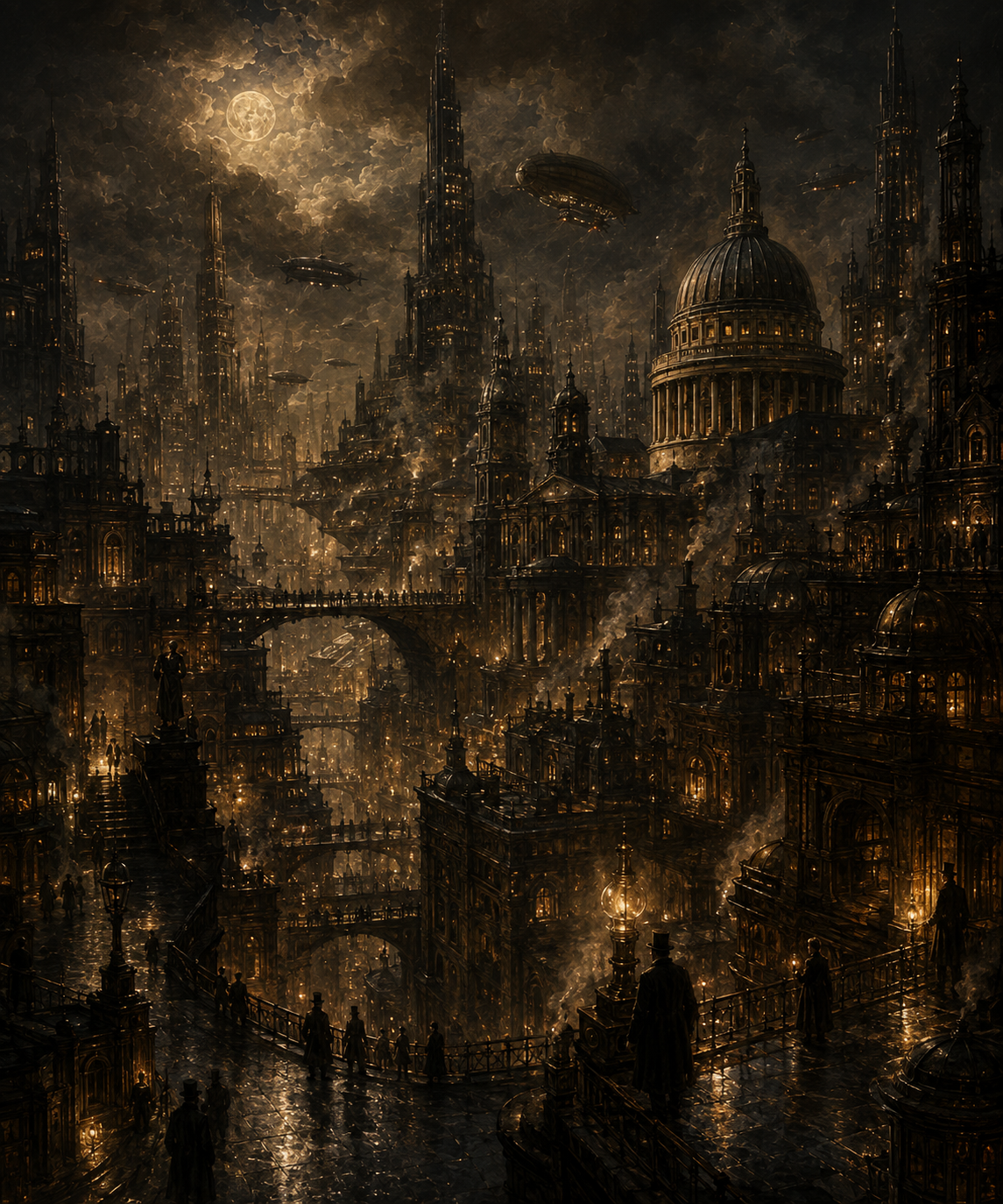
London has not simply grown larger. It has become architectural on a scale his century never imagined.
Buildings rise like cliffs along an immense enclosed avenue. Bridges cross enormous voids. Cables web the air. Great structures span distances that make individual people look insignificant.
Even daylight seems secondary beside the artificial illumination of the city.
Graham stares upward before he remembers to look down.
Above him, people move through the architecture in ways that seem almost impossible.
Figures cross suspended bridges. Others travel along steep cables and disappear into openings high in the buildings.
The city is not organised around streets in any form Graham recognises.
It is a machine for moving human beings.
Then he sees the roadway.
It is hundreds of feet across.
And it moves.
Closest to the buildings are platforms travelling with extraordinary speed, comparable in Graham's mind to the express trains of his own age.
Beside them run other platforms, each slightly slower.
The sequence descends toward a motionless central strip.
On the opposite side the pattern repeats in the other direction.
A traveller can move from one speed to another by stepping gradually between adjacent platforms.
The street has become continuous transport.
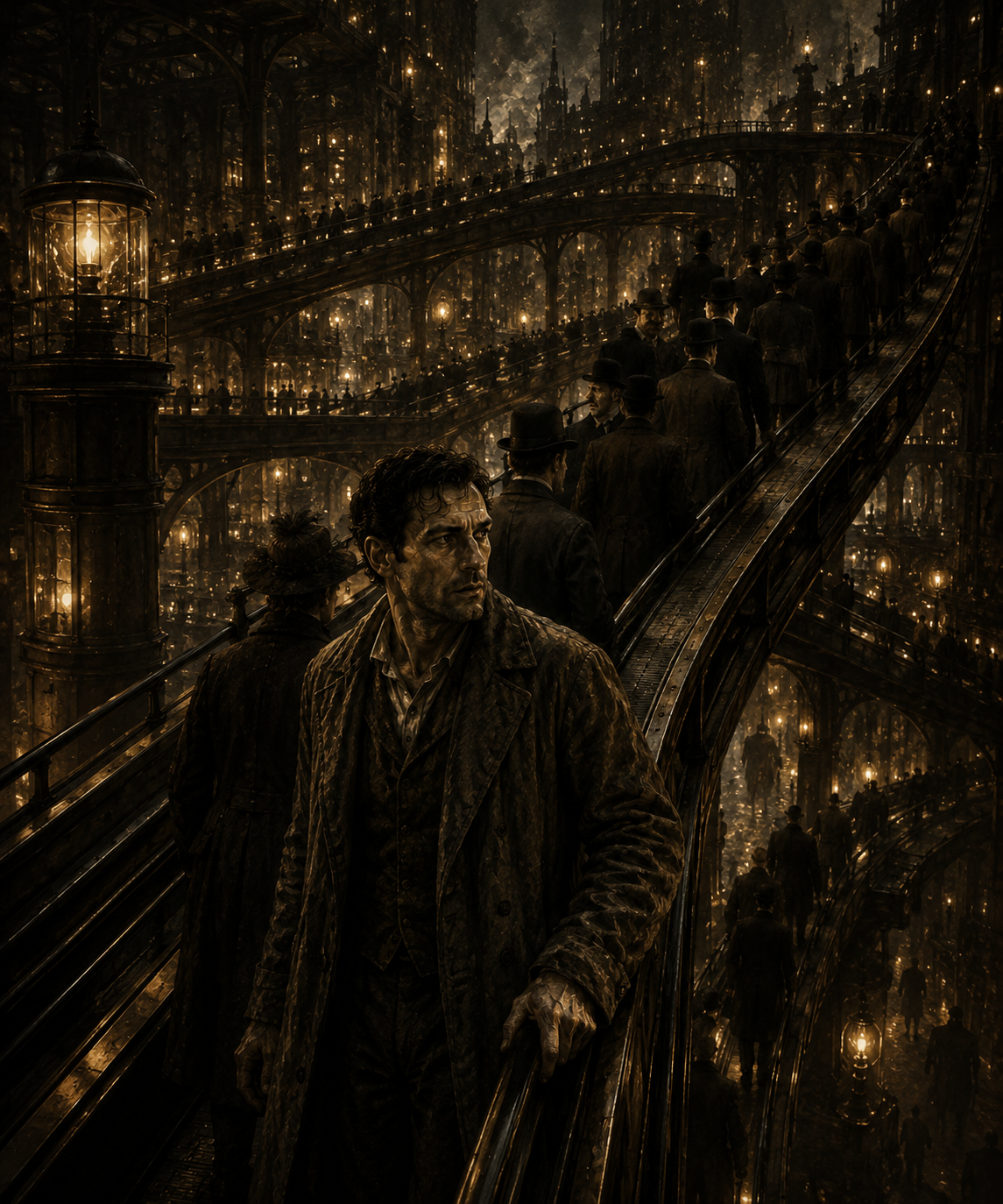
The Ways carry seats, kiosks and an immense population.
People sit, stand, change platforms and cross the stationary centre with the instinctive confidence of those who have used the system their entire lives.
Graham can barely absorb the engineering.
Then the people begin noticing him.
Faces turn toward the balcony.
Someone identifies the Sleeper.
Others deny it.
Then recognition spreads through the moving crowd faster than any official announcement could.
People point upward.
Voices multiply.
The Sleeper.
The Sleeper.
A struggle is already developing below.
Most of the population Graham sees wears pale blue. Figures in bright red uniforms work together around one of the stairways descending from the central area.
The crowd presses toward them.
The authorities push back.
People carried away by the Moving Ways simply jump across platforms and run back toward the confrontation.
Howard orders Graham away from the balcony.
Graham barely hears him.
The spectacle is too extraordinary.
For the first time he understands that whatever he has become in this age, the population already has an idea of what he represents.
The chanting changes.
Stop the Ways.
People run against the moving platforms so that they can remain opposite Graham.
Another name enters the shouting.
Ostrog.
Graham does not yet know who Ostrog is.
The crowd does.
Graham makes the mistake of behaving like an ordinary public figure.
He bows.
Then he waves.
The response is explosive.
The entire space seems to answer him.
To Graham it feels almost like popularity.
To Howard it looks like catastrophe.
Officials seize Graham and pull him away.
He resists more from confusion than strategy.
Within moments he is forced back through the building and into a lift.
The greatest city Graham has ever seen disappears from view.
But he has learned something that his guardians were trying very hard not to explain.
His awakening belongs to the people as much as it belongs to him.
The Moving Ways are one of Wells's most memorable pieces of future-city design: not just faster transport, but an entire urban street transformed into continuously moving layers. More importantly, Wells makes Graham's first real encounter with the future also his first encounter with mass politics.