ARCHIVE 001 · CHAPTER 04
THE SOUND OF A TUMULT
Graham learns how long he has slept — while London begins reacting to his return.
Graham wakes for the second time in the same extraordinary chamber.
The transparent enclosure is now open around him. Men in unfamiliar clothing watch him carefully while bells and distant shouting pulse through the building.
They reassure him that he is safe.
He has been asleep, they say, in a cataleptic trance.
That answer sounds almost ordinary compared with everything around him.
Graham's mind reaches instinctively toward his old life.
He asks whether anyone has wired his cousin Warming in Chancery Lane.
The word itself causes confusion.
An electric telegram belongs to history now.
The men surrounding Graham recognise the concept only after translating his nineteenth-century language into their own.
That small misunderstanding tells Graham more than their reassurances do.
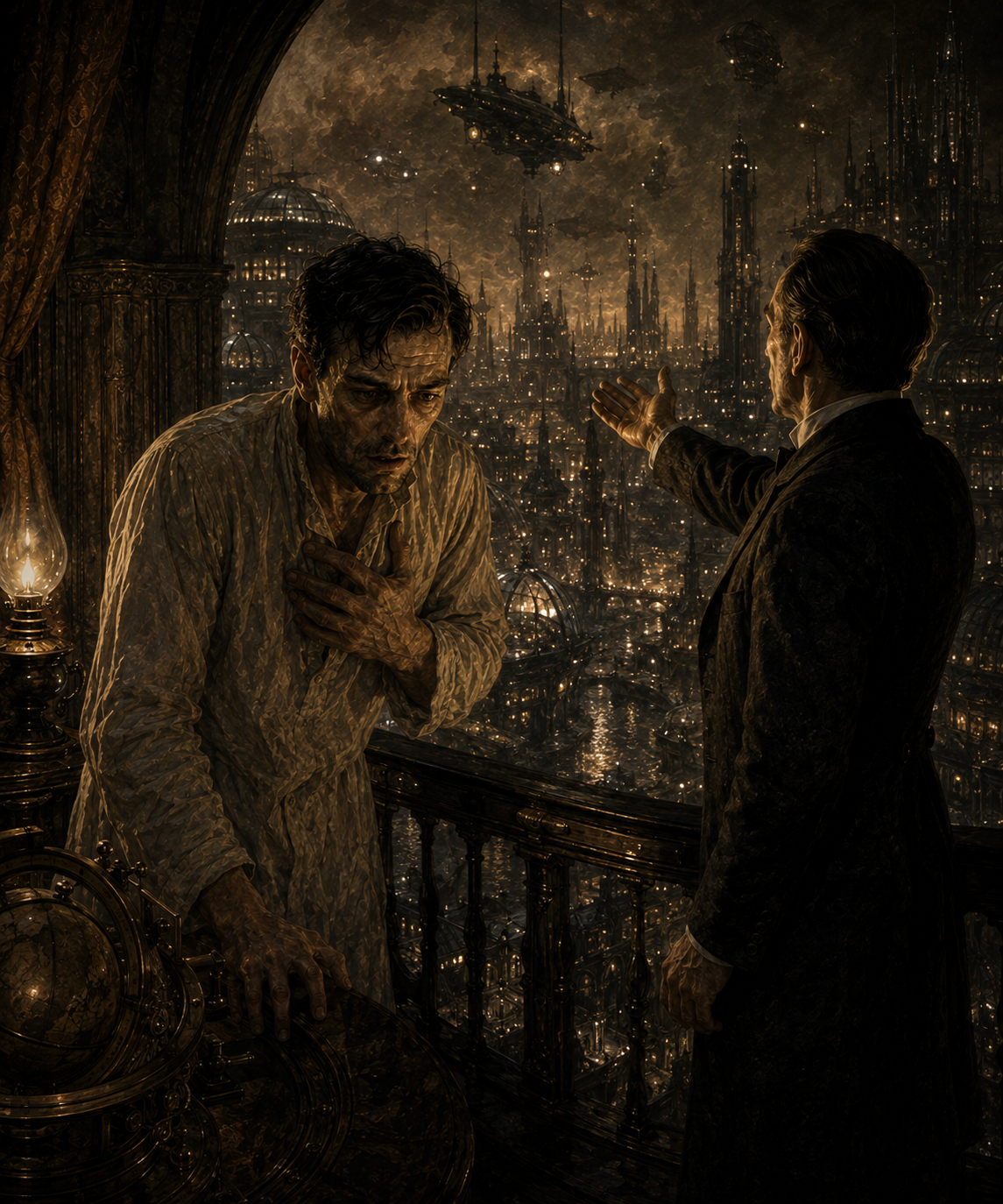
Something has happened to time.
He studies their faces.
They are not looking at an ordinary patient.
They are looking at something impossible.
Graham suddenly understands that his sleep must have lasted far longer than anyone wishes to tell him.
He asks the question directly.
How long?
The men evade him.
Years, they say.
Many years.
More than Graham expects.
He pushes harder until the answer finally emerges.
More than two centuries.
The number is almost meaningless.
Two hundred years.
Then Howard, the thickset and commanding guardian who takes control of the room, gives the precise figure.
Two hundred and three.
Graham tries to connect that span with the coast at Boscastle, Isbister, Warming and the Victorian world he remembers.
The connection breaks.
Every person he knew is dead.
Not merely friends and relatives.
An entire social world has vanished: monarchs, ministers, institutions, arguments, fashions, acquaintances, enemies.
He asks whether England still exists.
Whether London still exists.
It does.
He is already in it.
Grief arrives after disbelief.
Graham weeps.
Then another force interrupts his attempt to understand the loss.
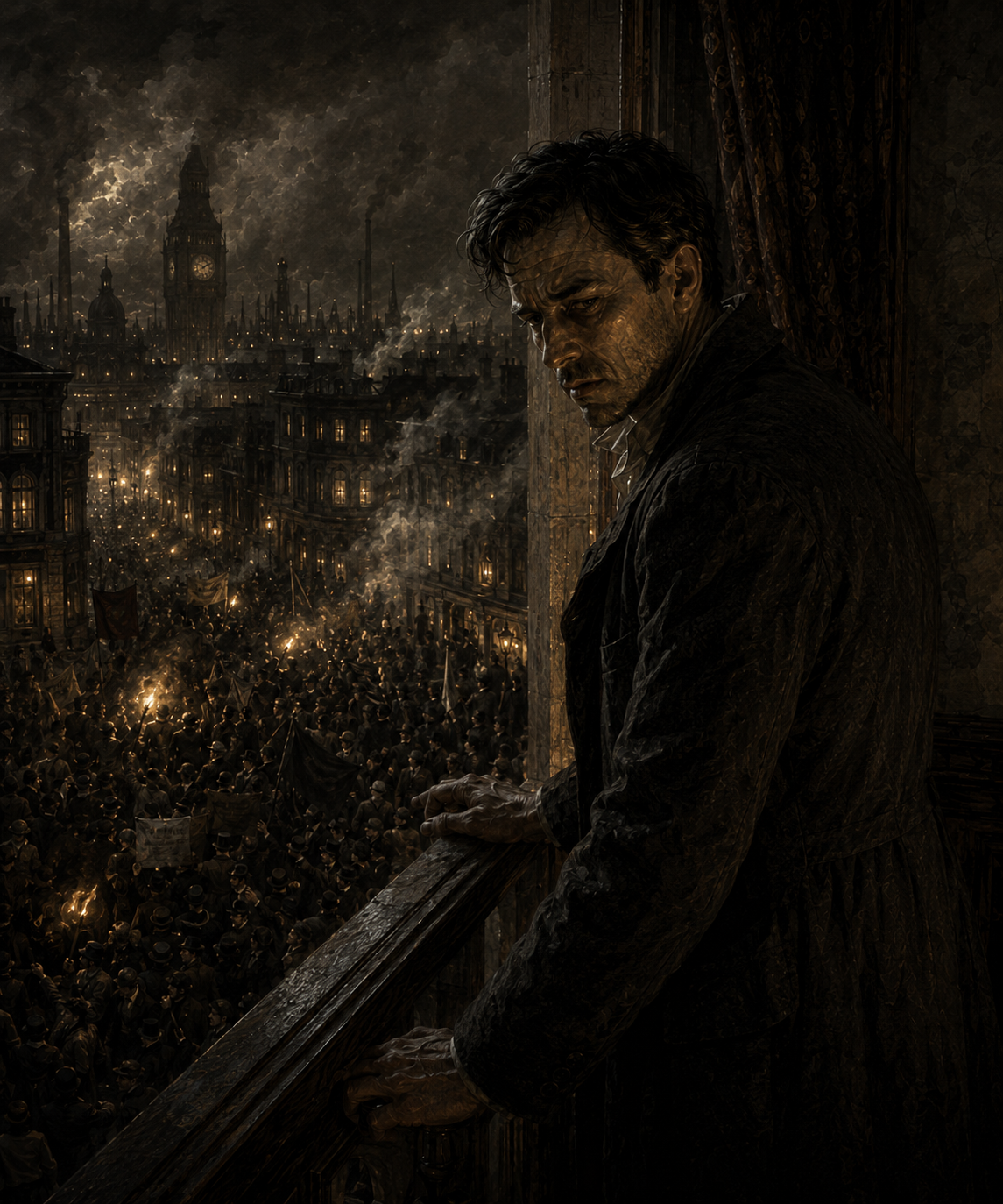
The crowd outside is growing louder.
They are shouting for the Sleeper.
Howard does not want Graham to hear too much.
He orders doors closed and information controlled. He insists that the awakened man must not be confused.
But Howard himself is visibly anxious.
Something political is happening beyond the room and Graham's awakening has made it worse.
The people already know.
The future begins dressing Graham for itself.
A tailor arrives with technology capable of measuring him almost instantly and producing new clothes with astonishing speed.
Even numbers and currency have changed. Graham learns that the familiar decimal habits of his age are obsolete.
A specialist cuts his hair and beard.
To Graham these details are absurd, fascinating and disorienting.
To Howard they are urgent logistics.
Then a voice erupts from a communication device.
The people know throughout the city.
Work is stopping.
Immediate action is demanded.
The roar from the balcony rises again.
Graham can no longer resist it.
He leaves the room and goes toward the crowd.
Chapter IV makes Graham's personal catastrophe and London's political crisis happen simultaneously. He is still trying to understand that everyone he knew is dead while other people are already fighting over what his awakening means.