ARCHIVE 001 · CHAPTER 03
THE AWAKENING
To Graham, no centuries have passed. He believes he has finally slept—and wakes inside a room that should not exist.
NO PRIOR KNOWLEDGE REQUIRED · RECORDS 005—006Graham entered an unexplained trance near Boscastle. Twenty years later he still had not aged, while his estate continued growing under the care of trustees.
Consciousness returns without a date, a warning or any sense that history has happened.
At first there is only sensation: weakness, confusion and the heavy sadness of waking near dawn. Graham remembers wanting sleep. He remembers the Cornish coast and a stranger speaking to him. Everything after that is blank.
He assumes he is in a bed at the hotel near Boscastle. Then his hand reaches toward the place where he normally leaves his watch and touches a smooth, hard surface.
The surprise pulls him fully awake.
He is naked on a yielding mattress inside a trough of dark glass. Beneath the partly transparent bed, a mirror gives back a grey reflection of his body. His skin is dry and yellow. A flexible apparatus is bound to his arm so neatly that it seems to enter the flesh.
Around the bed stands a greenish transparent enclosure. Beyond it is not a country lodging or hospital ward, but a vast, elegant apartment of unfamiliar materials.
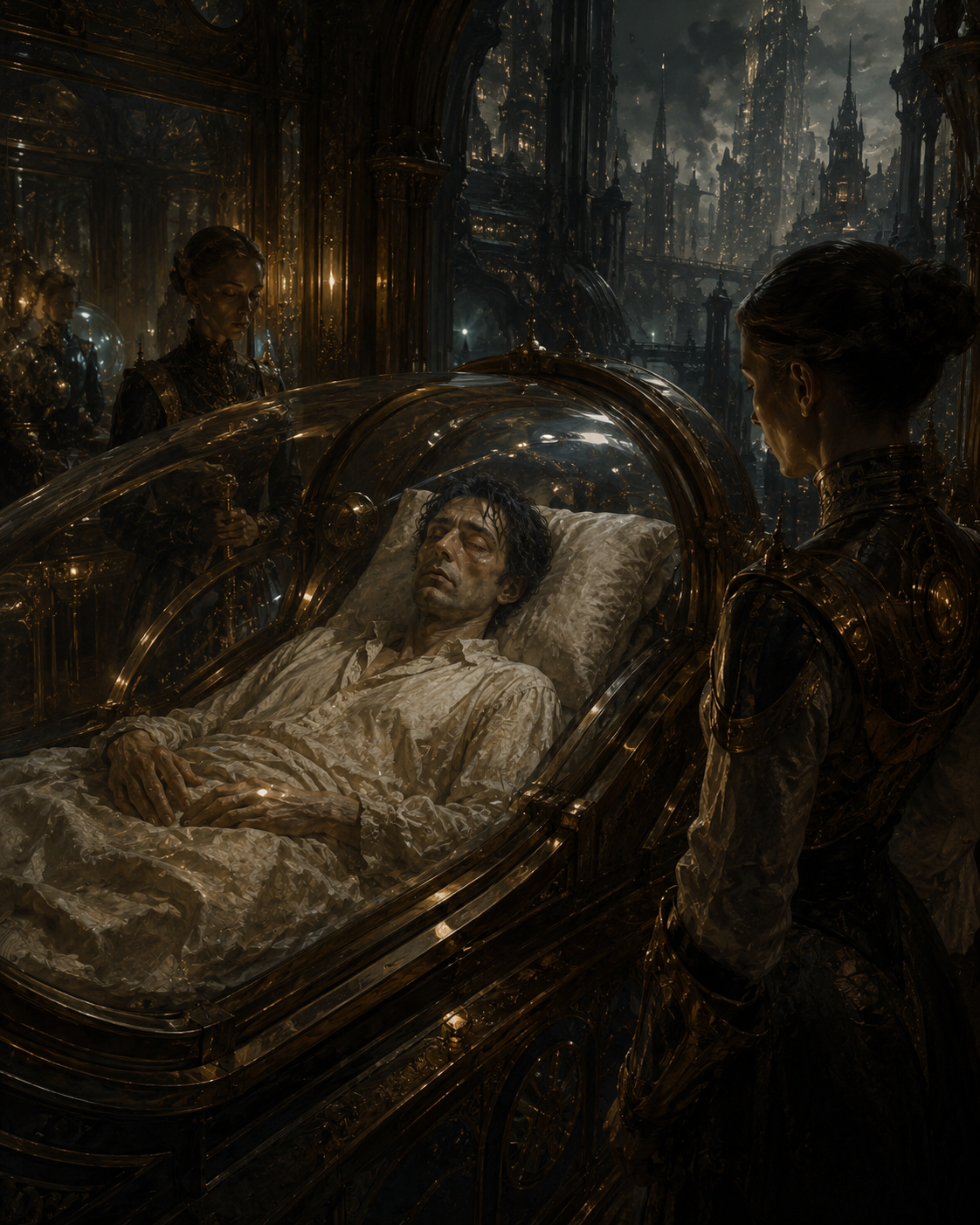
TWO CENTURIES LATER
Graham wakes with the memory of Cornwall still fresh, unaware that it belongs to a vanished age.
Graham's first clear sensation is hunger. It is reassuring because hunger belongs to the body he remembers.
He tries to stand and discovers how weak he has become. Reaching for support, he presses against the transparent wall. It bends outward and then vanishes with a small report, like a bubble punctured by his hand.
He stumbles into the larger room, catches a table and lowers himself into a chair. A glass falls but does not break.
The bottle on the table contains a clear liquid with a faint taste and an immediate restoring effect. Graham drinks, waits for strength and studies the room.
The architecture is clean and monumental rather than ornate. A large white arch leads to steps and a passage lined by deep blue pillars. From beyond comes the sound of hurried feet, many voices and a low mechanical drone.
Only then does Graham realise he is still naked.
A long black robe lies across a chair. He wraps it around himself because it is the first available garment.
To him, the choice is practical. To the people who will soon see him, the black-clad figure will look almost ceremonial: a man returned from legend already dressed for the role.
Graham follows the noise. His legs are uncertain, and the robe catches at his feet as he descends the steps.
The passage opens toward a brightly lit balcony suspended within an interior space so large that Graham cannot yet understand it. Vague architectural masses rise beyond the haze.
Three richly dressed men stand on the balcony with their backs to him, arguing over the crowd below.
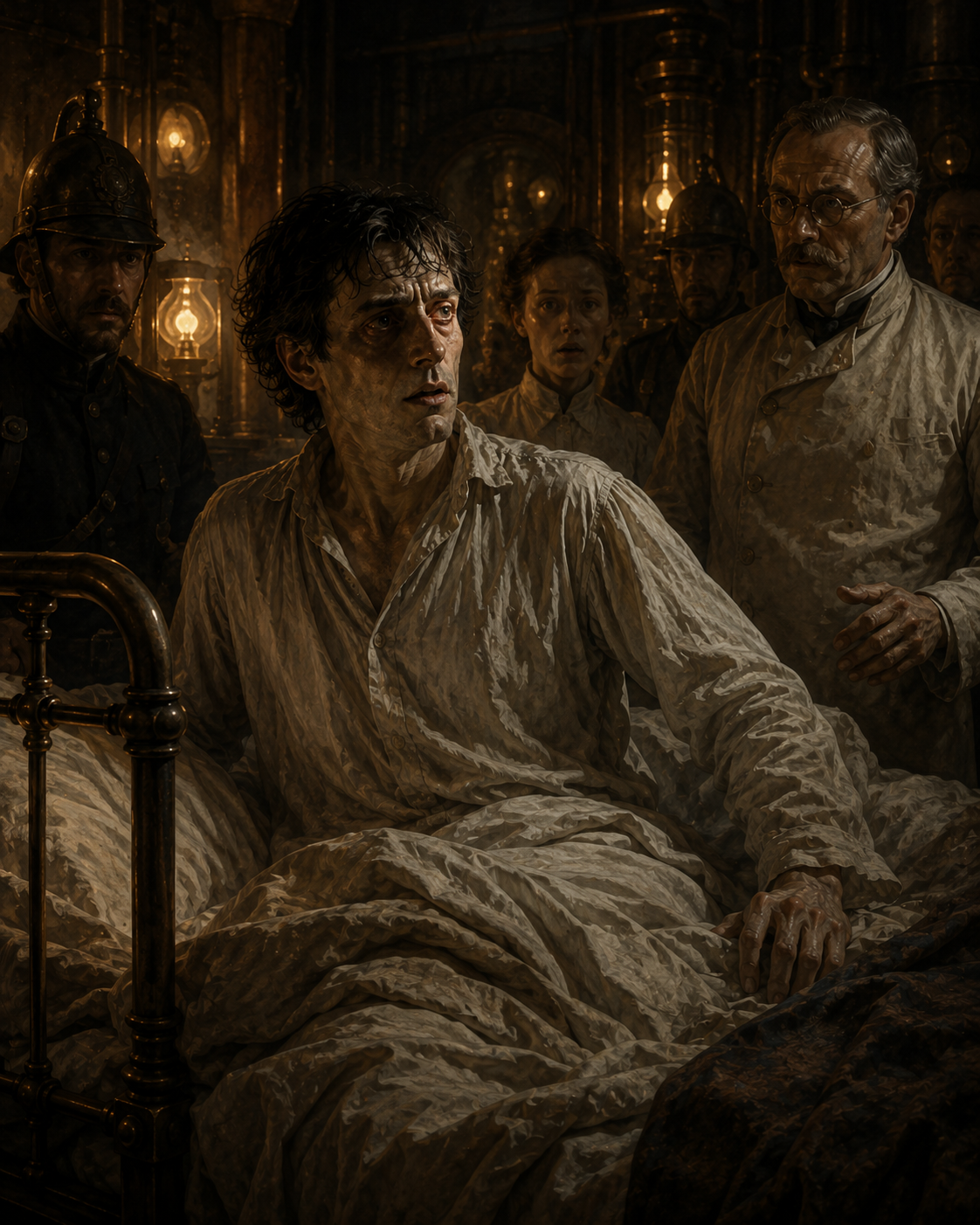
THE SLEEPER AWAKES
Three men turn and discover that a political legend is standing behind them.
They are talking about the Sleeper.
For them, the Sleeper is already a public idea—a name used in promises and jokes, a figure people invoke when imagining that the impossible might happen.
One of the men dismisses the latest disturbance with the familiar logic that everything will change when the Sleeper wakes.
Then he turns.
Graham is standing behind them in the black robe.
The man's expression changes so abruptly that the others follow his gaze. Conversation stops. All three stare at the weak stranger as if a monument has stepped down from its pedestal.
Graham knows only that he has woken in a place he does not recognise. The men know something far more alarming: a person whom their society treated as permanently unconscious has returned.
Before he can ask a question, his strength gives way.
He collapses.
Beyond the balcony, thousands of voices continue to rise.
Why does nobody tell him the date?
Wells lets Graham encounter the future physically before he understands it historically. Strange materials, medical apparatus, architecture and crowd noise arrive first. The number of years comes only after the reader has shared his disorientation.
Why this chapter matters
The black robe is accidental from Graham's point of view, but visually powerful. This is a recurring Sleeper Archive idea: ordinary actions become symbols when other people already possess a story about you.
FOR READERS REVISITING WELLS
The chapter's slow reconstruction of consciousness is central to Wells's method. Graham does not wake as a fully informed hero. He has to rebuild the self first, then discover that the world around that self has vanished.