ARCHIVE 001 · CHAPTER 02
THE TRANCE
Graham does not wake. The world begins to age around a body that has stepped outside ordinary time.
NO PRIOR KNOWLEDGE REQUIRED · RECORDS 003—004Six nights without sleep ended when Graham became rigid and unresponsive in Isbister's room. A doctor was summoned, but no treatment could restore him.
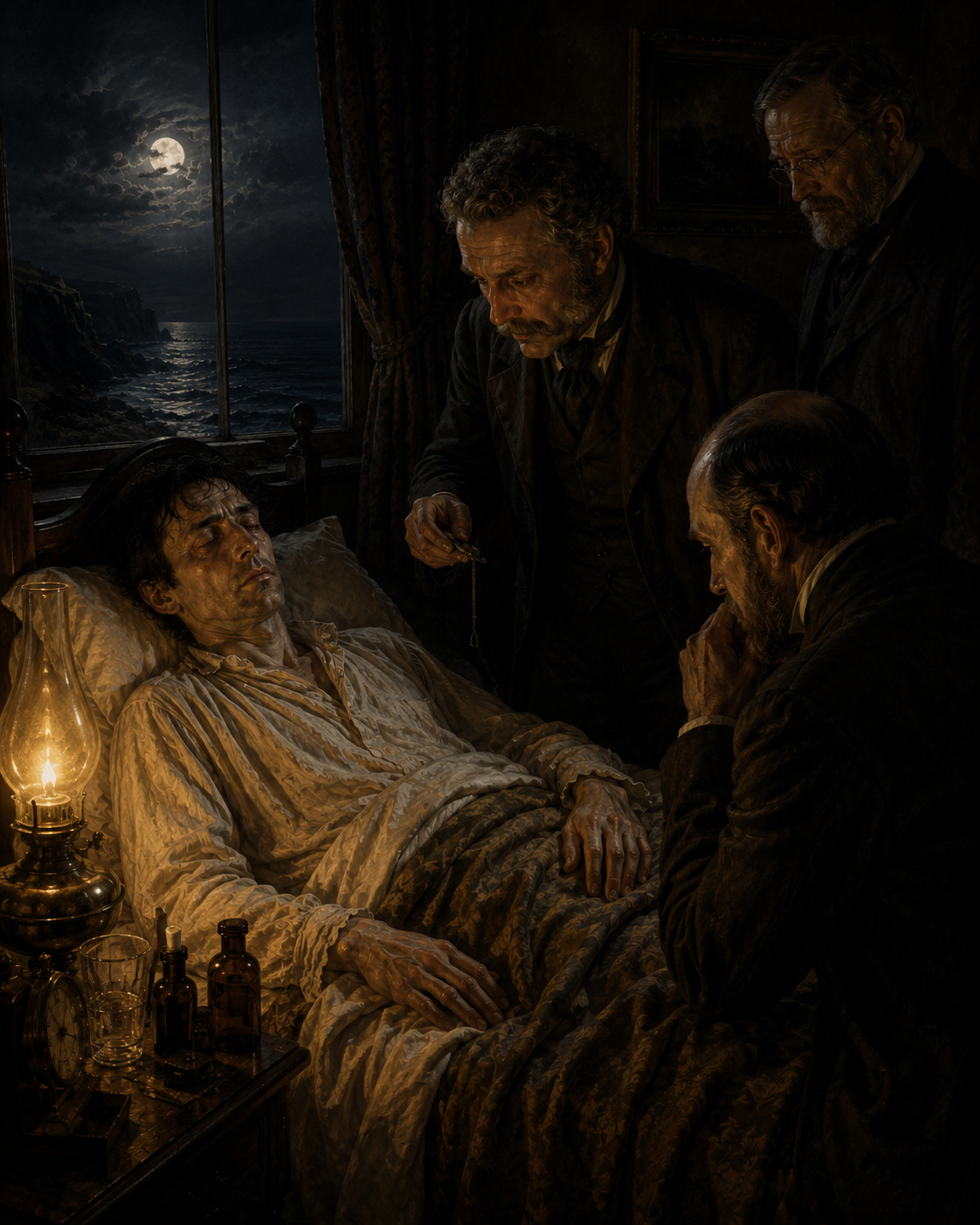
The first phase of Graham's condition is terrifying: his body remains fixed in whatever position it is placed, as though life has stopped without quite becoming death.
THE TRANCE
Medicine can maintain Graham's body, but cannot explain where the man himself has gone.
The local doctor tries every method he can imagine. Graham is stimulated, pricked and subjected to crude electrical treatment. His muscles react, but the man himself does not return.
After the rigid phase passes, his body becomes relaxed. His eyes can be closed. He appears to be resting peacefully, yet there is no ordinary heartbeat, digestion or response to the world around him.
He is moved from the hotel to the Boscastle surgery. Weeks later he is taken to London, where specialists can observe and preserve him.
For Graham, none of these journeys exists. There is no dream, no awareness of voices and no sense of time. The mental whirlpool that tormented him ends in a silence so complete that even darkness would be too much to call it.
Twenty years pass.
Isbister returns to see the stranger he found on the cliff. The young artist is now grey-haired, married and the father of a grown son. He abandoned fine-art ambition for commercial work and built a life Graham never witnessed.
With him stands Warming, a London solicitor and Graham's nearest relative. Warming knew Graham before the trance and has administered his affairs ever since.
The two men look through a thin glass case at a figure who appears almost unchanged. Graham lies on a water-bed, lean and yellowed but still recognisably young. Marks on his body show where physicians have introduced nourishment to prevent physical collapse.
The contrast is the true horror of the scene. Isbister and Warming have accumulated experience, family, regret and age. Graham has accumulated nothing.
The outside world has not paused either. Wars have begun and ended. Technology has changed. Public life has moved on. Ideas that seemed urgent when Graham collapsed have become history.
Isbister tries to imagine what waking would mean. Graham would open his eyes expecting the old world and discover that everyone has changed except him.
Warming is less optimistic. The trance appears to exhaust Graham very slowly. Perhaps the sleeper is not preserved forever, only dying at a pace too gradual to notice.
They discuss Graham's character. He had been gifted, emotional and undisciplined. Domestic trouble had driven him toward radical politics, and a furious period of writing and argument helped produce the overwork that destroyed his sleep.
Some of his political predictions already look foolish. Others have become fact. Should he wake, Warming says, he will have much to learn and much to unlearn.
COMPOUND INTEREST
While Graham remains absent from the world, his estate begins a life of its own.
Then Isbister asks about money.
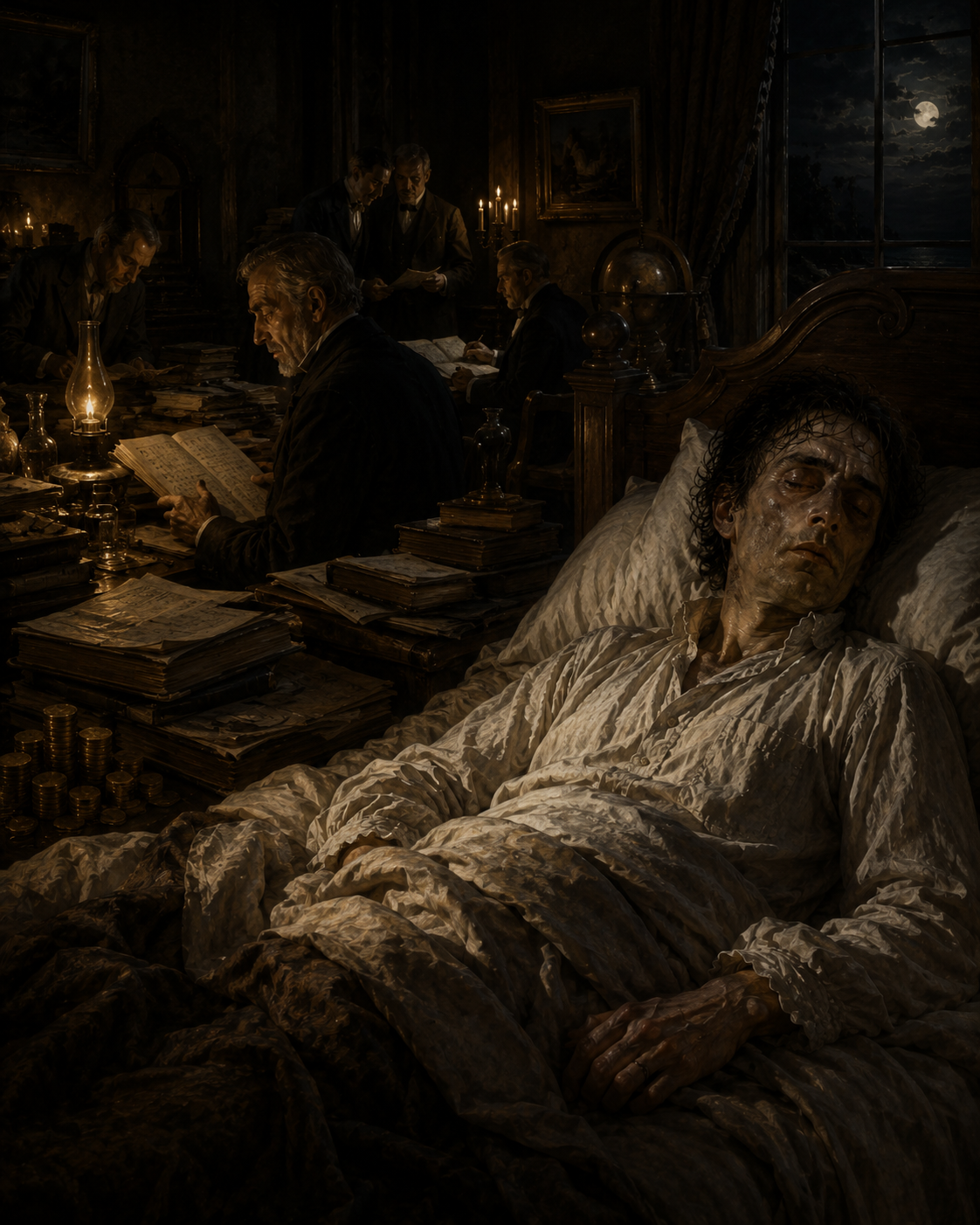
Graham possessed a moderate estate before the trance. Its owner cannot spend it, and the cost of maintaining him is small. Warming has invested the remainder.
The result after twenty years is simple: the fortune has grown.
That creates a legal problem no ordinary inheritance law anticipated. Graham is not dead, so the estate cannot pass naturally to heirs. He is not conscious, so he cannot direct it. If Warming dies first, someone—or some institution—must become guardian of both the sleeper and his property.
They imagine handing him to a public body capable of outliving an individual trustee. Even that seems absurd. Governments and institutions are not truly immortal; they only pretend to be.
Through all their uncertainty, compound interest continues its work. Graham's body does nothing. His money earns money.
Isbister would like to live long enough to see the surprise on Graham's face if he ever wakes.
Warming looks at the motionless figure and says that he never will.
The judgement feels final.
It is also wrong.
Why does the money matter?
Graham's fortune is the mechanism that connects the intimate opening to the future political story. Because he neither spends, dies nor inherits in the normal way, capital can accumulate across generations under trustees. The later world will be shaped not only by his long sleep, but by what ownership does while its owner is absent.
Why this chapter matters
This chapter jumps twenty years without letting Graham experience a second of them. Wells makes time visible through Isbister and Warming: their altered bodies and changed lives show what the sleeper has lost.
FOR READERS REVISITING WELLS
The references to political prophecies and social change remind returning readers that Graham was not politically blank before the trance. His later resistance to Ostrog grows partly from convictions formed in his own century.