ARCHIVE 001 · CHAPTER 01
INSOMNIA
Before Graham became the owner of the future, he was simply a man who could no longer sleep.
NO PRIOR KNOWLEDGE REQUIRED · RECORDS 001—002On a bright afternoon above the Cornish sea, a young artist named Isbister finds a stranger sitting beneath the cliffs in visible distress.
The place is Pentargen, a small cove near Boscastle. Isbister has walked there to sketch and inspect the caves. The stranger has come for a very different reason. His eyes are red, his face is wet with tears, and his hands hang uselessly over his knees.
The two men are embarrassed by the encounter. Isbister begins with a remark about the weather, the kind of empty politeness people use when they do not know what else to say. The stranger answers briefly, then gives him the fact that has reduced his world to a single problem: he cannot sleep.
Not badly. Not intermittently. He has had no sleep at all for six nights.
The stranger's name is Graham, though Isbister does not yet know it. He is intelligent, isolated and exhausted beyond ordinary tiredness. He has sought medical advice, but the drugs offered to him feel dangerous. His sleeplessness began with overwork and with stimulants taken to force his body beyond its natural limits.
He had decided that the body's demands—food, exercise, rest—were thefts from the life of the mind. Coffee and stronger stimulants helped him finish the work he had set himself. When the work ended, the effort did not. His thoughts kept turning at full speed with nowhere to go.
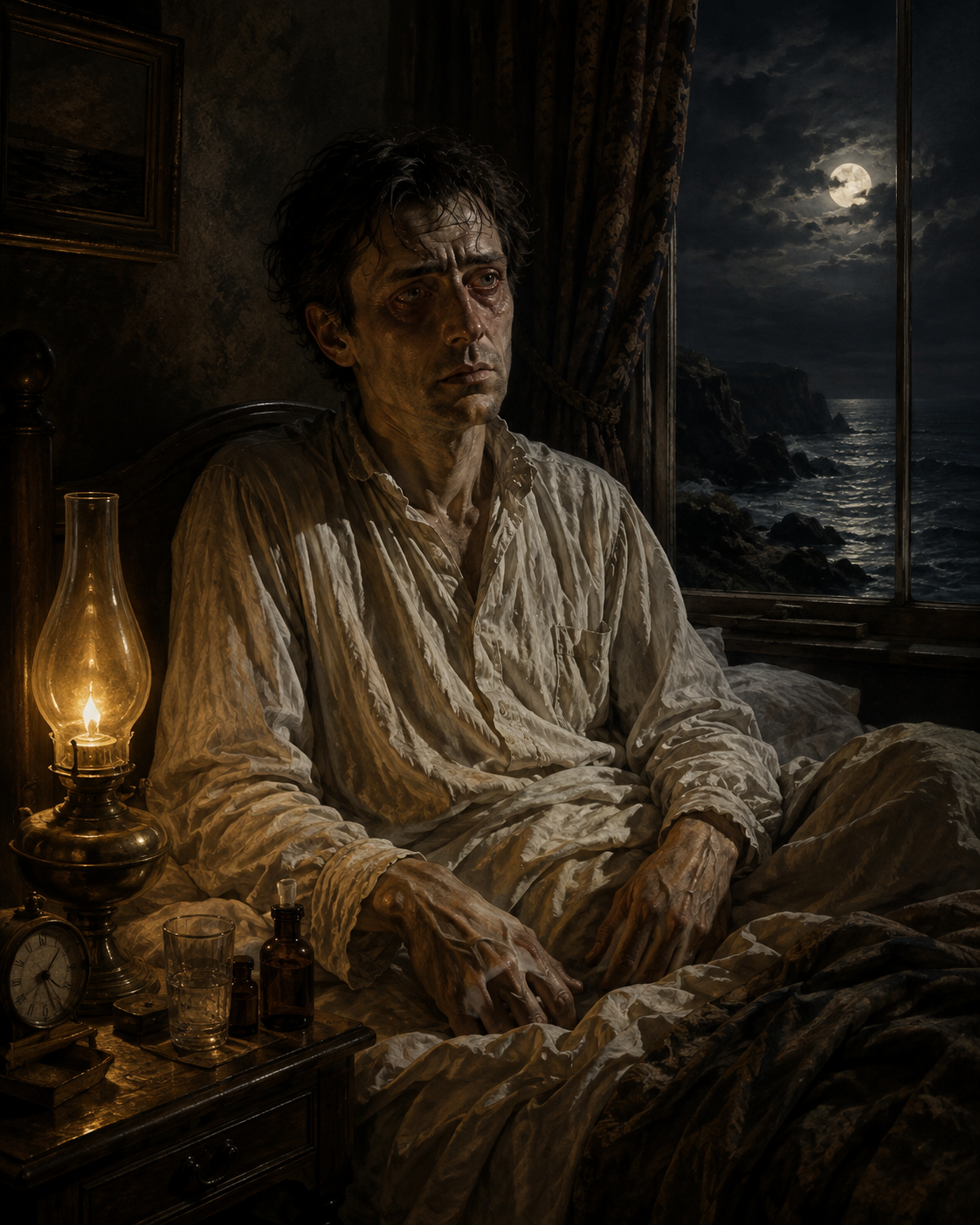
SIX NIGHTS
A chance meeting above the Cornish sea interrupts Graham's final descent into despair.
Graham has spent days walking the coast from New Quay, hoping physical fatigue would quiet his brain. Instead he has added aching muscles to mental torment. The sunlight, sea and cliffs that delight Isbister only sharpen Graham's sense that he has been excluded from the ordinary world.
He describes himself as solitary, without wife or children, and without any duty strong enough to hold him in place. The language is not theatrical to him. He believes he is approaching the edge of sanity.
Then he looks toward the precipice and says aloud what Isbister has begun to fear: death seems like the only sleep still available.
Isbister does not answer with a grand moral speech. He attacks the fantasy practically. A fall may not kill cleanly. It may leave a person broken, cold and conscious among the rocks. Then, with the awkward audacity of a young artist, he calls suicide by cliff amateurish.
The remark is almost absurd, but it interrupts Graham's fixed idea. That interruption matters. Isbister sits beside him and keeps talking.
Isbister has no medical training and no clear plan. What he offers is company. He treats Graham less like a spectacle and more like a man who should not be left alone.
Eventually he persuades Graham to climb back toward Boscastle. Graham follows obediently, but his condition is changing. He begins speaking in fragments. His hand circles in the air as he describes thoughts spinning endlessly around a centre.
At Blackapit, he tells Isbister that a shadow seems to be falling across the activity in his mind. It is not the drowsiness he has begged for. It feels heavier, as though the entire whirl of thought is being covered over.
By the time they descend toward Isbister's lodging, Graham is stumbling. He scarcely appears aware of the road, the gate or the room he enters.
Isbister offers cigarettes, alcohol and sketches—anything ordinary enough to keep the situation manageable. Graham refuses the drink almost absently. He sits heavily in an easy chair, leans forward with his forehead in his hands, and becomes still.
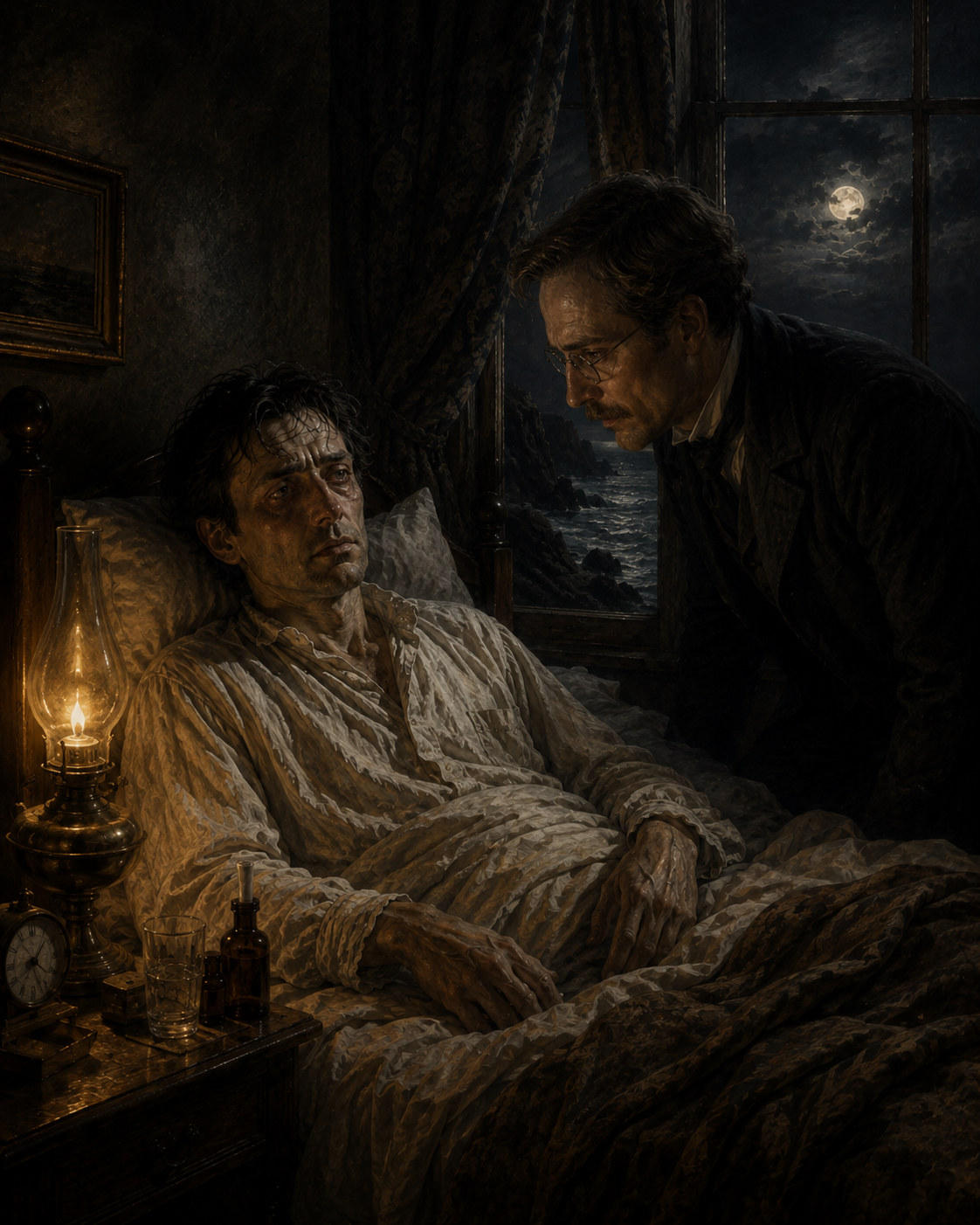
ARE YOU ASLEEP?
Isbister discovers that the stillness in his chair is neither natural sleep nor ordinary death.
At first Isbister is relieved. After six impossible nights, perhaps sleep has finally come.
He moves quietly around the room. He opens his portfolio, watches the clock and whispers an invitation to supper that receives no answer. Not wanting to wake his guest, he steps outside and observes him through the open window.
Evening settles over Boscastle. Children pass on the road. Sailors sing from the harbour. Bats appear. The figure in the chair does not change position.
Relief becomes curiosity, then unease.
Isbister returns to the dark room and listens. There is no sound of breathing. He bends close and sees that Graham's eyes are open, but only the whites are visible; the pupils have rolled beneath the lids.
He grips Graham's shoulder and asks whether he is asleep.
There is no response.
For one terrible moment, Isbister believes the stranger is dead. He calls for a lamp, sends for a doctor and turns the quiet lodging into a scene of alarm.
The six sleepless nights are over. But Graham has not entered ordinary sleep.
Who is Graham?
Graham is not yet a hero, ruler or legend. At the beginning he is a troubled man from the late nineteenth century: gifted, emotionally exhausted and convinced that his life has narrowed to a dead end. Everything that follows grows from the fact that this private crisis becomes an impossible physical event.
Why this chapter matters
Wells opens his future story without a machine in sight. The first chapter is intimate, coastal and psychological. The future begins because one exhausted man wants nothing more extraordinary than a night's sleep.
FOR READERS REVISITING WELLS
Readers who remember the novel may notice how carefully Wells makes Isbister ordinary. He is not a chosen guardian or scientific genius. His small acts of companionship delay a tragedy and place him beside an event that will eventually reshape the world.