ARCHIVE 001 · CHAPTER 06
THE HALL OF THE ATLAS
Graham is carried from the shouting streets into the chamber where the world has been ruled in his name.
Howard pulls Graham away from the balcony before the crowd can turn recognition into open revolt.
The transition is violent in its speed. One moment Graham is looking down upon the Moving Ways and thousands of people shouting his name; the next he is inside a lift, carried upward through the hidden machinery of the city.
He demands explanations. Howard gives fragments.
London, he says, is living through a period of unrest. Graham's awakening is connected to it. Exactly how, Howard still refuses to say.
The route itself overwhelms Graham.
He is hurried through public-service passages filled with tubes, cables and conduits, past rooms where teaching appears to be delivered by machines, past red-uniformed officials who salute Howard, and across a glass bridge hundreds of feet above the Moving Ways.
Far below, red police and the blue-clad population are still struggling around the place where Graham appeared.
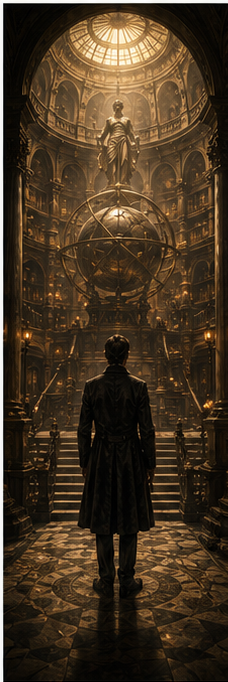
Then Graham is brought into a hall unlike anything he has seen.
At the far end stands an enormous white figure of Atlas, bent beneath the globe.
Beneath that image, almost absurdly small by comparison, a handful of men in white robes stand around a table.
They are the Council.
No one greets Graham as an equal. He is placed on a gallery and watched.
Howard crosses the immense empty floor to speak with them.
Graham waits under guard.
The symbolism is impossible to miss: Atlas carries the world above them, while the Council gathers beneath him and the awakened Sleeper is kept at a distance.
Graham still does not understand that he is the other Atlas in the room.
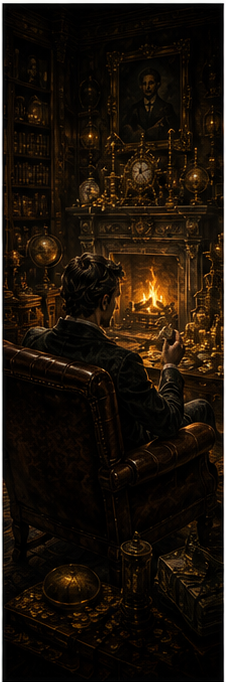
When Howard returns, the evasions finally begin to break.
Graham asks about his property.
He remembers the small estate Warming administered before the trance. He expects perhaps that some portion of it survived.
Howard explains that it did far more than survive.
Through investment, accumulation, inheritance and consolidation, the Sleeper's holdings expanded across generations until they became one of the central structures of world ownership.
That is why the Council matters.
They govern the system built upon Graham's fortune.
They have exercised power while Graham remained asleep.
His awakening introduces something the structure was never designed to tolerate: the legal owner has returned.
The crowd outside does not merely worship an old curiosity. They believe the Master has come back to claim what is his.
Wells makes the Hall of the Atlas a visual argument about concentrated ownership. The gigantic Atlas and the tiny Council beneath him foreshadow the revelation that Graham's fortune has become the load-bearing structure of political power.