ARCHIVE 001 · CHAPTER 07
IN THE SILENT ROOMS
The richest man in the world is given every comfort except information, freedom and a door he can open.
NO PRIOR KNOWLEDGE REQUIRED · RECORDS 013—014Howard has admitted that Graham's forgotten estate grew into a foundation of world power. The White Council governs through it, yet Graham was kept outside the Council's discussion and locked away immediately afterward.
The rooms are beautiful, quiet and perfectly arranged. That is what makes the imprisonment feel so deliberate.
Graham sits with folded arms and tries to order the first hours of his new life: the transparent bed, the date, the Moving Ways, the crowd, the Hall of Atlas and Howard's incomplete account of his fortune.
The scale of the inheritance is still impossible to picture. So is the idea that people may have died in the struggle he witnessed below.
For a moment he returns to the hope that all of this is a dream. He shuts his eyes, waits and opens them again.
Nothing changes.
He begins examining the rooms because objects are easier to question than people.
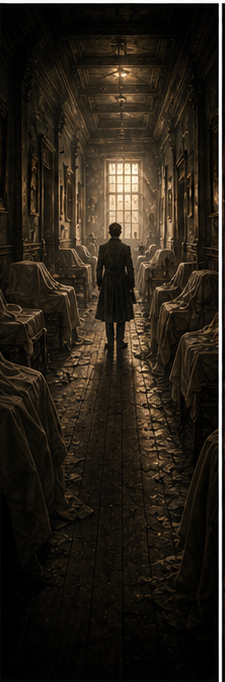
THE SILENT ROOMS
A room that automates comfort also isolates its occupant from news, books and human choice.
There are no ordinary windows. A wheel of broad vanes turns in an opening high in the domed ceiling, drawing air upward. Through the moving blades Graham catches brief glimpses of a star.
Faint lamps hidden around the cornices fill the apartment with steady light. There is no fireplace, no smoke and almost no visible domestic labour. The walls and furniture possess a spare elegance unlike the crowded ornament of Graham's century.
A table carries drinks and clear food resembling jelly. The bed and washing arrangements seem designed to service themselves.
The room offers an advanced answer to every physical inconvenience.
It offers no answer to the one question that matters: why is he locked in?
Graham notices another absence. There are no books, newspapers, pens or paper.
One wall is filled instead with rows of paired cylinders labelled in phonetic spelling. After some effort, he recognises the titles of stories. The cylinders are books only in the sense that they preserve a work for replay.
He places one inside a square apparatus. Colour appears on its smooth face. Tiny figures move, speak and perform a drama with a realism beyond any theatre Graham knows.
Within minutes he hears his own legend used as a joke. A character dismisses some distant promise with the phrase 'when the Sleeper wakes.'
Graham has been awake for days. To the culture outside the room, his return still belongs to the category of impossibility.
The recorded drama becomes his first unfiltered view of ordinary life in the new age.
Its people are energetic, pleasure-seeking and morally different from those of Graham's world. Their relationships and assumptions confuse him, but the economic struggle beneath the story is familiar.
Again and again, common people appear in pale-blue canvas. The garment is more than fashion; it marks a social position.
The future has perfected machines without perfecting human life.
When the drama ends in tragedy, Graham remains before the blank screen, burdened by a society he has glimpsed but cannot yet interpret.
Howard returns with food and reassurance. Graham has now been kept in the rooms for three days.
He demands to know the extent of his estate and the exact nature of the Council's authority. Howard admits that the automatic growth of Graham's property gives him the potential to interfere with arrangements built over generations.
Nobody truly expected the Sleeper to wake. The legal system preserved Graham as owner while practical power passed to those who administered the ownership.
Howard speaks as though continuity itself justifies the Council. Graham hears something else: the rulers have become accustomed to a world in which his consent is unnecessary.
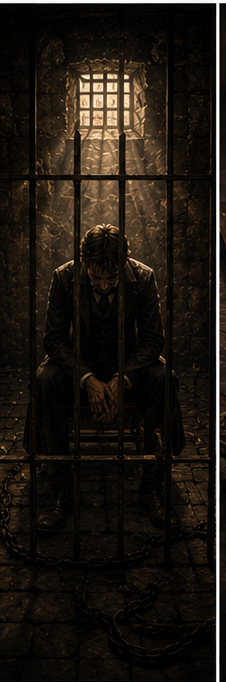
PRISONER OF HIS FORTUNE
Graham's wealth gives him theoretical power and gives the Council a reason to keep him powerless.
The guardian attempts distraction. If Graham is lonely, companionship can be arranged. Pleasure, entertainment and every comfort of the age are available.
The offer enrages him. He does not want to be entertained inside his own captivity.
He threatens to appeal to the people and challenge the Council publicly. Howard calmly treats the outburst as a message he will deliver, then steps through the noiseless door before Graham can stop him.
Graham rages after he is left alone, partly because anger is easier to bear than fear.
Eventually the fear forms a clear question: if the Council needs an unconscious owner, what advantage is there in keeping the awakened man alive?
A line from the distant past returns to him: it may be expedient that one man die for the people.
This time, Graham may be that man.
Why not simply kill Graham?
The Council governs as trustee of Graham's property. His survival helps preserve the legal structure, but his awakening threatens it. That creates a dangerous contradiction: the rulers need the Sleeper as an owner who cannot exercise ownership. Graham does not yet know whether they intend to drug him, persuade him or remove him permanently.
Why this chapter matters
The room is a compact model of Wells's future. Technology abolishes inconvenience while institutions abolish agency. Graham is warm, fed and entertained—and still cannot leave.
FOR READERS REVISITING WELLS
The cylinders include titles that were contemporary or recent literature in Wells's own time. The joke works in two directions: Graham recognises some works as modern, while the future treats them all as old recordings in an obsolete archive.