ARCHIVE 001 · CHAPTER 10
THE BATTLE OF THE DARKNESS
The city's lights fail in ten seconds. A triumphant march becomes a battle in which nobody can see more than a flash at a time.
NO PRIOR KNOWLEDGE REQUIRED · RECORDS 019—020Ostrog's supporters have told Graham that he is Master of the Earth because the Council governs through his estate. When Graham appeared before the crowd and gestured toward the Council, thousands began marching in his name.
The revolution sounds orderly at first: a song, a rhythm and thousands of feet striking together.
Graham leaves the theatre on a raised gallery above one of the great avenues. Guards in black move before and behind him. Below, every level of the Moving Ways is crowded with people flowing toward the government quarter.
The marching song has lost the polish of organised music. It is coarse now, carried by untrained voices and the repeated impact of feet.
The buildings opposite appear strangely empty. Bridges and cables that should hold spectators are deserted.
Graham feels the first pulse of danger before he understands its source.
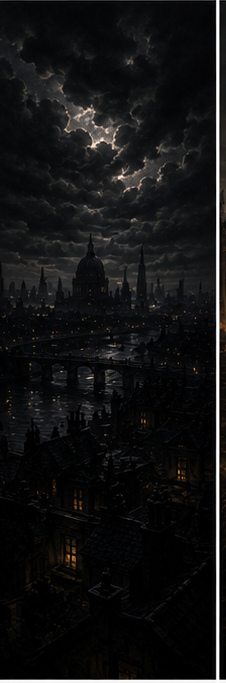
THE LIGHTS GO OUT
The Council turns London's electrical infrastructure into a weapon against the crowd.
The huge electric globes overhead begin to throb.
Light tightens and releases, turning faces and buildings into alternating glare and shadow. The marching rhythm breaks. People stop and look upward.
The white globes become purple, then red, then fading points.
In ten seconds, the city is dark.
The vast crowd does not vanish. It becomes sound: shouting, collision, fear and conflicting orders.
Lincoln tells Graham that the Council has cut the electrical current.
Hands grip Graham's arms. Guards shout that the Sleeper must be protected. Somewhere below, people scream.
Then weapons begin firing.
Small flashes run along the Ways, each one revealing an instant of bodies and movement before darkness returns.
The red police have attacked.
A rebel high above the avenue raises a brilliant artificial light on a cable. For a moment the darkness rolls back.
Graham sees red-uniformed forces jammed against the building while blue-clad crowds surround them. Weapons rise and fall. Smoke spreads from the unfamiliar carbines.
The light makes the scene comprehensible only briefly. When it fails, the battle becomes blind again.
Other lights flare elsewhere, dividing the violence into disconnected pictures.
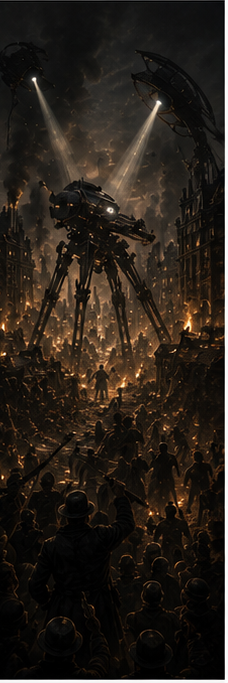
BATTLE OF THE DARKNESS
The revolution becomes a sequence of violent images illuminated only by gunfire and temporary lamps.
The temporary lights do not restore order; they create targets.
Whenever one flares, combatants can see where to fire and where to run. When it is shot down or carried away, memory of the scene persists longer than the light itself.
Graham begins understanding how little any individual knows. A person may cheer a victory on one platform while another group is being overwhelmed a few metres away.
The city is too large, and the darkness too complete, for anyone inside the battle to possess Ostrog's commanding view.
The protective formation around Graham breaks.
He is pushed, carried and separated from Lincoln among people who cannot recognise him in the dark. The Master of the Earth becomes another frightened body trapped in a crowd.
In the intermittent flashes, he sees the cost of the march: injured people on the platforms, dead bodies held upright by pressure, attackers and defenders striking at shapes they barely identify.
There is no heroic view from which the battle makes sense.
Graham climbs over barriers and escapes into passages, following any route that seems to lead away from the firing.
He returns eventually to the Ways, but they have stopped. Without power, the system that organised London's movement has become a series of dark troughs.
He is alone, exhausted and unable to read much of the phonetic signage around him.
The irony is complete. Millions may call him owner, yet he cannot navigate one street of his property.
Still, one knowledge has survived the chaos: the people are fighting for the Sleeper.
Graham now needs to discover what they believe they are fighting for.
Why can the Council darken the whole city?
The government controls central infrastructure. London's artificial lighting and Moving Ways depend on systems administered from above, so the Council can interrupt ordinary life as a defensive measure. Wells uses this to show that control of utilities is a form of political power.
Why this chapter matters
The chapter removes the clarity of banners, uniforms and speeches. Graham experiences mass politics as physical confusion, revealing the human cost hidden inside words such as revolt and victory.
FOR READERS REVISITING WELLS
Wells repeatedly writes the march as a beat—'tramp, tramp'—and then destroys that rhythm with darkness. The sound design of the chapter matters as much as the visual action.