ARCHIVE 001 · CHAPTER 16
THE MONOPLANE
Among all the future's systems, Graham finds one thing he understands at once: the desire to fly.
NO PRIOR KNOWLEDGE REQUIRED · RECORDS 031—032At a reception for the future's elite, Helen Wotton warned Graham that ordinary people remain oppressed and expect the Sleeper to change their lives. Lincoln immediately drew him away toward London's flying stages.
The flying stages rise above south London like artificial plateaus built for the sky.
There are six of them, grouped in pairs and still carrying the names of old districts: Roehampton, Wimbledon Park, Streatham, Norwood, Blackheath and Shooter's Hill.
Each platform is several kilometres long, built from a light metal stronger than the iron Graham knew. Lifts and stairways climb through open frameworks to broad launch surfaces above the roofs.
Aircraft do not rise from ordinary streets. They are carried along inclined guides until speed and air take over.
To Graham, the stages are both railway terminal and harbour—except every departure points upward.
ASANO
Asano guides Graham through the practical future while crowds struggle to reach their inaccessible Master.
He travels there with Asano, the Japanese attendant who now manages much of his daily life.
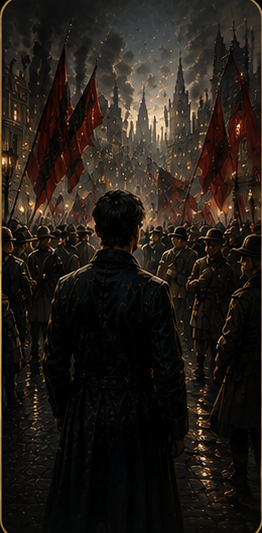
Crowds form as soon as people recognise the Master's guard. Blue-clad workers pour onto the Ways, shouting and attempting to push petitions toward him.
Graham cannot understand most of their dialect, and the police keep them at a distance.
The encounter should trouble him after Helen's warning. Instead, the machine waiting on the stage captures his attention.
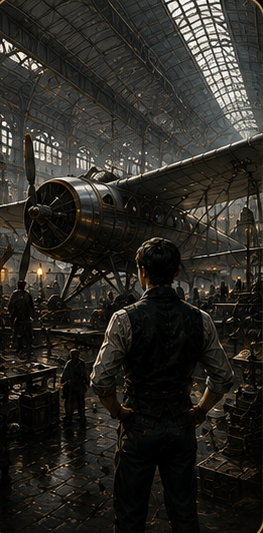
The monoplane is larger than its name suggests. Its aluminium body has the scale of a small ship, with wide supporting surfaces stretched like the translucent wings of an insect.
The pilot and passenger sit within a skeletal frame protected by air cushions and wind guards. The engine drives a propeller at the rear.
Graham chooses to leave the passenger enclosure open. He wants the experience without a wall between himself and the air.
Asano remains on the platform while the machine begins moving.
The first seconds are frightening.
The stage slides backward. The horizon tilts. Wind strikes Graham's face, and the roofs fall away beneath his feet.
When he looks directly down, physical terror grips him. A wind vane turns hundreds of feet below, and the flying stage has already shrunk into a dark shape covered with tiny people.
He forces himself to look forward.
The panic passes.
THE MONOPLANE
Flight turns Graham from a bewildered passenger in history into an eager student of the new age.
Then fear becomes exhilaration.
The monoplane crosses London and accelerates into open sky. The engine's rhythm, the pressure of air and the smooth obedience of the machine produce a kind of freedom Graham has not felt since waking.
Politics, property and the demands of the crowd temporarily vanish.
The future is no longer only something done to him. It is something his body can learn.
The flight carries him toward the Continent. He sees Paris and the distant shape of the Eiffel Tower, now one remnant among structures from later centuries.
A vast aeroplane passes nearby—a flying vessel capable of carrying people and equipment on a scale far beyond the monoplane.
Graham's curiosity shifts immediately from passenger to student.
He asks the aeronaut to teach him the controls.
The pilot hesitates. Aeronauts protect their professional knowledge through a powerful guild, and unauthorised instruction is forbidden.
Graham points out the obvious advantage of making an exception for the man who is supposed to own the system.
The lesson begins.
Very quickly the monoplane is climbing, diving and turning in tight spirals. Graham laughs into the rushing air. For the first time, the title Master seems to describe a skill rather than a legal fiction.
The joy is interrupted when the machine strikes a swan Graham never saw.
A white shape tumbles behind them, and drops mark the pilot's forehead.
The incident sobers Graham. Speed expands freedom and danger at the same time.
They return at sunset to a stage surrounded by people celebrating his safe arrival.
Graham steps down determined to learn more.
The skill appears to be a private delight.
Before the story ends, it will become his final responsibility.
Who is Asano?
Asano is Graham's Japanese attendant and guide. He belongs to the future rather than the political old order Graham remembers, and he can explain everyday systems without the deliberate secrecy Howard used. His position is still one of service, however, and later chapters reveal limits to how far he will challenge authority.
Why this chapter matters
The chapter gives both Graham and the reader relief from politics. That relief is purposeful: the pleasure of flying makes his distraction believable and quietly prepares the only practical skill he will possess during the final crisis.
FOR READERS REVISITING WELLS
Wells imagined the monoplane with mechanical specificity—launch carriers, open frames, air cushions and professional restrictions. Preserving those details prevents it from becoming a generic modern aircraft pasted into the future.