ARCHIVE 001 · CHAPTER 15
PROMINENT PEOPLE
The future's elite gather to welcome the new Master. One young woman refuses to let celebration hide the people who paid for it.
NO PRIOR KNOWLEDGE REQUIRED · RECORDS 029—030From the crow's nest, Graham saw a global civilisation of enormous cities, concentrated trusts and Pleasure Cities. His estate reaches through the entire system, but Ostrog still controls its practical machinery.
Revolution is followed almost immediately by a reception.
The state apartments of the wind-vane chief are built at the scale of a public monument. Broad steps descend into galleries of white, mauve and purple. Bridges cross the interior, music falls from unseen sources, and thousands of guests move through the space without ever seeming crowded.
The people waiting for Graham are not the blue-clad workers who marched on the Council.
They are officials, relatives of officials, celebrities and members of institutions powerful enough to survive a change of government.
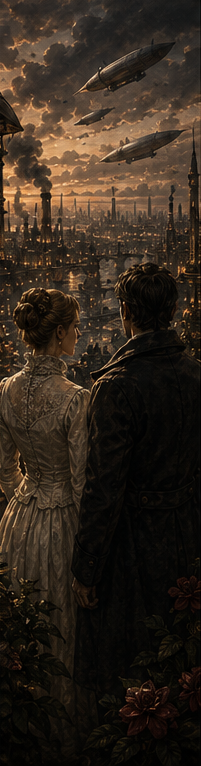
PROMINENT PEOPLE
The new court forms around Graham before the wounds of the revolution have closed.
Their clothing astonishes him. Men dress as elaborately as women, borrowing forms from Renaissance Europe, classical fashion and East Asian design. Gesture itself is taught as part of a wealthy person's education.
Everyone appears polished, expressive and physically cultivated.
The gathering is a display of freedom from necessity. Nothing about it resembles the exhausted faces Graham saw during the revolt.
The new elite receives him with restrained applause—the manners of people too important to appear impressed.
Lincoln identifies the prominent guests.
There are aeronautic officials whose neutrality helped defeat the Council, controllers of wind power, managers of food systems, a bishop and a poet laureate who does not write poetry but holds the office through family and club connections.
Graham learns that titles and traditions survive even when their original functions disappear.
A king still exists somewhere in the social order, but has been expelled from one fashionable circle for being excessive.
The future is new in machinery and ancient in status.
A senior education official explains the school system.
Children no longer sit traditional examinations. Recorded teaching and psychological methods can produce knowledge efficiently.
But education is not distributed equally. The children of workers are trained mainly in obedience, punctuality and the limited skills required by their class.
Teaching them too much, the official suggests, would only create dissatisfaction.
Graham hears the statement amid luxury, delivered as practical common sense.
The reception flatters and distracts him.
People ask about his century, praise his survival and introduce him to amusements. For a time, Graham enjoys being remarkable.
Then the revolutionary song rises faintly from the Ways outside.
It is cut off abruptly.
The silence reminds him that a city full of people is watching while its Master is entertained by those already close to power.
Graham notices the young woman from the theatre walking through the gallery.
A guest identifies her as Helen Wotton, Ostrog's niece, and jokingly describes her as one of the most serious people alive.
When Graham speaks to her, Helen remembers the night of the revolt differently from the surrounding guests.
Countless people, she says, were prepared to die for him. Many did.
HELEN'S WARNING
Helen asks Graham to remember the ordinary people whose hopes transformed him from sleeper into Master.
She lowers her voice as Lincoln approaches.
The common people are unhappy, oppressed and misgoverned. They believed Graham's awakening would alter their condition, not merely replace the Council with another administrator.
Graham begins to answer that he knows nothing.
Helen agrees. That is precisely the danger.
Before she can explain further, Lincoln arrives and redirects Graham toward his next spectacle: a waiting aeroplane.
Graham leaves, but Helen's warning remains.
The reception has shown him the people who know how to reach every new ruler.
Helen has asked him to remember those who cannot.
For the first time, the question of what he should do begins to compete with the question of what the future can show him.
Who is Helen Wotton?
Helen is Ostrog's niece, but she does not share his detached view of power. As a child she saw Graham's sleeping body displayed to the public. She understands how the Sleeper became a symbol of hope and believes the awakened man must answer that hope personally.
Why this chapter matters
The chapter is social satire and political warning at once. Wells shows an elite capable of absorbing revolution into ceremony almost immediately. Helen interrupts that process by bringing the dead and oppressed back into the room.
FOR READERS REVISITING WELLS
The education official's cheerful defence of limited schooling is one of the novel's sharpest details. Technological improvement in teaching does not guarantee emancipation when institutions decide in advance what different classes are permitted to learn.