ARCHIVE 001 · CHAPTER 14
FROM THE CROW'S NEST
Graham sees the civilisation he supposedly owns from a thousand feet above London—and learns that the city has swallowed almost everything else.
NO PRIOR KNOWLEDGE REQUIRED · RECORDS 027—028The White Council has surrendered. Ostrog directs the new government, while Graham has been publicly proclaimed Master of an estate that reaches through much of the world's economy.
After the first ordinary sleep of his new life, Graham wakes not as a prisoner but as the recognised head of the world.
The change is immediate. Attendants dress him with elaborate deference. A dignified Japanese official named Asano supervises his household and speaks English with the ease of a native Londoner.
From Asano and Lincoln, Graham learns that the revolution is already being treated as fact. London has resumed business. Many cities abroad welcome the Council's fall, while others are still deciding which side to recognise.
Graham asks to walk among the people, but the excitement around him makes an ordinary appearance impossible.
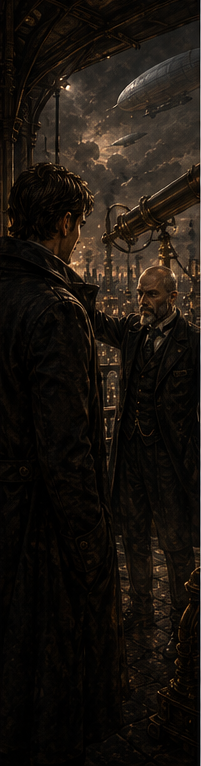
Instead, Lincoln offers a view from the crow's nest of the chief wind-vane tower.
THE CROW'S NEST
A thousand feet above London, Graham sees the revolution reduced to one damaged district inside an immense functioning system.
A small cradle draws Graham upward along a filigree mast until he is roughly a thousand feet above the roofs.
The platform is little more than a disc exposed to open air. Below it turn the specula—the remote viewing devices through which Ostrog watched the revolt.
The day is clear, warm and almost springlike. For the first time Graham sees London under natural sunlight rather than artificial illumination or smoke.
The serenity is deceptive. Beneath the roofs, improvised hospitals still hold the wounded, and thousands lie dead from the fighting.
From above, however, the revolution occupies only a small scar around the Council House.
The rest of London continues its immense routine. Wind vanes roar over the city, drawing power from the sky. Work crews reconnect cables through the ruins. The flying stages rise in the distance, crowded with victors.
The contrast unsettles Graham.
A political order that seemed to fill the whole universe during the battle has changed almost nothing in the appearance of the city as a whole.
The sunlight conceals what the roofs contain.
From the platform, Graham can almost forget the improvised wards, the nurses and the bodies hidden inside the city. The revolution appears as a small crater inside a calm expanse.
That visual distance is dangerous. A system can look peaceful from above while thousands experience it as injury, hunger or command below.
Graham has been given the viewpoint of ownership before he has learned the viewpoint of those owned by the system.
MASTER'S WORLD
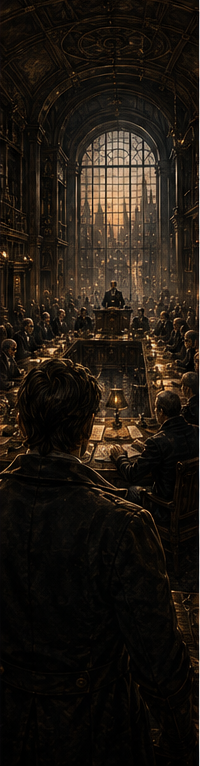
City after city, trust after trust, the planet has become an estate whose legal ownership points toward one absent man.
Asano explains what happened to the countryside Graham remembers.
London expanded outward and absorbed towns, fields and roads. Agriculture became highly mechanised, allowing small numbers of engineers to produce what once required masses of labourers.
Workers travel between vast urban settlements and managed production zones rather than living in independent villages.
The Thames itself has been reshaped. Land, waterways and food systems belong to trusts that treat geography as infrastructure.
The city has not merely grown. It has swallowed humanity into a new stage of social life.
Graham tries to imagine the rest of the world.
There are cities along rivers, coasts, plains and mountains, linked by rapid transport and global systems. Languages have merged, spread and changed. Local cultures survive inside a civilisation organised on an international scale.
Across this city-set earth, Graham's property extends from region to region.
The statement is difficult to understand emotionally. He owns neither through memory nor labour. His name simply sits at the end of chains of title accumulated while he was absent.
In the distance lie the Pleasure Cities—places devoted to art, entertainment, beauty and consumption for those who profit from the economic struggle below.
They glitter as both promise and warning.
The future has created wonders Graham's century could not build, but access to those wonders remains unequal.
The old man called Graham owner of the world. From the crow's nest, the phrase finally becomes visible.
So does the burden.
Property on this scale is not merely wealth. It is responsibility for the conditions under which civilisation operates.
What changed outside London?
The future is overwhelmingly urban. Mechanised agriculture and large trusts reorganised food and land, while transport allowed people and production to concentrate around enormous cities. Wells imagines political and economic systems operating globally long before globalisation became an everyday term.
Why this chapter matters
Height changes Graham's perspective twice. The city becomes easier to comprehend physically and harder to comprehend morally. From above, suffering is invisible; ownership appears as a clean network rather than lived dependence.
FOR READERS REVISITING WELLS
Wells's global geography contains period assumptions about empire, language and race. The core idea remains powerful—a city-based world integrated by technology and capital—but a modern retelling should identify the historical lens rather than repeat it as neutral prediction.