ARCHIVE 001 · CHAPTER 13
THE END OF THE OLD ORDER
The White Council surrenders. Graham is acclaimed as Master before he has had time to decide what mastery should mean.
NO PRIOR KNOWLEDGE REQUIRED · RECORDS 025—026Graham has reached Ostrog, who revealed that the revolt was built by capturing labour organisations, communications and flying stages. Ostrog now wants the Sleeper's image to legitimise victory across the world.
The end of a government first appears as a strip of cloth climbing a flagpole.
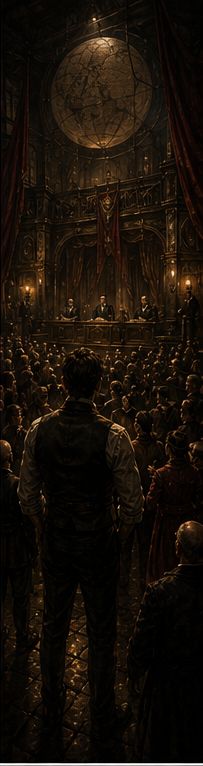
THE COUNCIL SURRENDERS
The flag changes before Graham fully understands that a global political order has collapsed.
Ostrog is preparing Graham for his global appearance when a signal interrupts the room.
The speculum shows the Council House. Its white flag has disappeared. A black banner rises in jerks above the building.
The Council has surrendered.
For Graham, who was its prisoner only hours earlier, the speed is difficult to comprehend. An authority that ruled for generations has ended during the first week of his conscious life in the future.
Lincoln arrives from the packed public halls. The people are demanding to see Graham.
Ostrog keeps a firm hand on the Sleeper's arm and makes an unusually revealing remark: his movement armed the people, so for today their wishes must be law.
The qualification matters. Ostrog speaks of popular power as a temporary condition produced by mobilisation, not as a permanent principle.
Graham is still too overwhelmed to challenge the distinction.
He is dressed again in black, the colour that the public now associates with the Sleeper.
On the way to the theatre, Graham briefly sees a medical ward. Blue-clad bearers carry covered bodies. Surgeons move among blood-stained couches while injured men groan behind white walls.
The glimpse lasts only seconds before architecture hides it.
That is enough. The victory presented through maps and specula has been purchased by individual bodies.
The people gathering to celebrate are also people who have buried friends.
Ostrog explains how Graham will be shown beyond the theatre.
Remote photographic systems can carry a magnified black-and-white image of the Sleeper to halls across the world. London alone contains more than thirty million people; abroad, cities from New York to Paris are waiting for proof that the owner has truly returned.
The technology makes one body politically present in places Graham cannot imagine.
It also allows Ostrog to stage every detail: the black robe, the lighting, the angle, the sentence and the bow.
The theatre is brilliantly lit and packed to every level.
Graham stands within an intense circle of light so that his magnified image can be projected before the crowd and transmitted to cities abroad.
Ostrog remains near him, almost part of the stage machinery.
Graham delivers the short phrase prepared for him. He has awakened; his heart is with the people.
The response is deafening.
To the audience, the Master has spoken freely. Only Graham knows how little of the message was his.
Afterward, fatigue overwhelms him. He sleeps deeply—the first ordinary sleep he has experienced since the six nights in Cornwall.
When he wakes, the revolution is already becoming administration. Business resumes. Officials reorganise. Orders travel through systems that served the Council only days before.
A change of rulers can happen quickly because the machinery of rule remains available.
Graham, meanwhile, is still learning the names of the machinery.
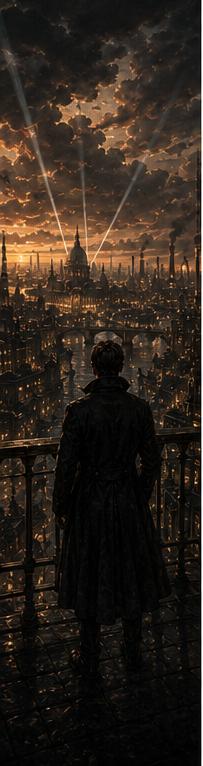
THE END OF THE OLD ORDER
The White Councillors leave their stronghold and submit before the man in whose name they once ruled.
He is later taken to the ruined government quarter for the Council's formal submission.
The landscape has been torn open. Buildings are shattered, cables severed and temporary lights erected through the wreckage.
Crowds occupy every available surface.
Against this destruction, the surviving Councillors emerge in white robes from the dark building where they made decisions for more than a century.
The defeated rulers approach Graham and Ostrog while the crowd roars abuse and triumph.
Graham recognises faces from the Hall of Atlas: men who once appeared distant and untouchable now look exhausted, anxious and human.
Their eyes repeatedly pass beyond Graham toward Ostrog.
They understand where practical power now lies.
Graham stands at the centre of the ceremony, but Ostrog stands at the centre of the outcome.
The old order ends in public.
The people shout that Graham is Master. The Councillors submit. Black banners replace white.
Yet the central questions remain unresolved.
Does Graham's ownership make him ruler? Has the revolution transferred power to the people, to Ostrog or simply back to the legal owner?
Graham has escaped captivity and gained a world.
He has not yet decided what he owes it.
Has Graham really taken power?
Legally and symbolically, Graham is now Master. Practically, Ostrog controls the revolutionary network, armed supporters, communications and administration. The surrender removes the Council but does not settle who can make the new order function.
Why this chapter matters
The chapter separates spectacle from power. Graham occupies the brightest place on the stage, yet Ostrog scripts the words, manages the crowd and receives the defeated Councillors' anxious attention.
FOR READERS REVISITING WELLS
The fleeting medical ward is one of the chapter's most important images. It interrupts the triumphant pace and prevents the reader from treating political change as a clean exchange of flags.