ARCHIVE 001 · CHAPTER 12
OSTROG
Graham goes looking for the strategist who organised a revolution around a man he never expected to meet awake.
NO PRIOR KNOWLEDGE REQUIRED · RECORDS 023—024An old citizen has explained the hidden history of Graham's estate: twelve trustees turned two centuries of accumulation into the ruling Council. Ostrog's revolt uses Graham's legal ownership to challenge that government.
Finding Ostrog sounds simple. In a city whose language, streets and customs are unfamiliar, it becomes another journey through the dark.
Graham leaves the old man and follows the rumours moving through London.
People hurry past shouting that the Council has capitulated or that dozens of defenders have been captured. Ostrog's name appears in every burst of celebration.
Graham cannot be certain which reports are true. He has already learned that public information in this age arrives through propaganda, gossip and machines controlled by competing powers.
Still, the emotional direction is unmistakable. The city believes the Council is losing.
He asks for the wind-vane offices, where Ostrog is said to command the revolt.
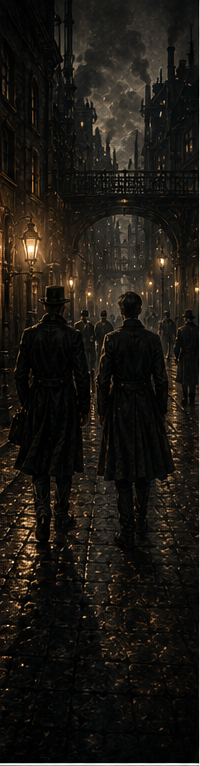
Directions lead him through cross-Ways, dining galleries and unfamiliar stairways. Dialects that have developed among different classes sometimes sound like separate languages.
In one dark passage a young woman approaches with easy familiarity, laughs and disappears when Graham protests.
Elsewhere he finds two frightened children crouched beside a railing, too afraid to speak until he moves away.
The future is not only grand architecture. It is ordinary vulnerability inside that architecture.
FIND OSTROG
The supposed owner of London navigates it as a lost stranger while rumours of victory race ahead of him.
Eventually Graham reaches a Moving Way and receives directions he can understand. The wind-vane offices lie two miles away in Westminster.
As he approaches, electricity returns.
The city leaps from twilight into illumination. Processions occupy the Ways, carrying black banners and singing fragments of the revolutionary song.
For everyone around him, the return of light appears to confirm victory.
For Graham, visibility creates a new danger. If the wrong people recognise him, he may be captured again before reaching Ostrog.
The headquarters are surrounded by crowds cheering the Sleeper—the same man now trying to enter unnoticed.
Guards dismiss his claim that he must speak with Ostrog. Graham's clothes and exhausted appearance do not resemble their public image of the Master.
He changes tactics. Instead of insisting on his identity, he says that he carries information Ostrog must hear personally.
A message travels inward.
The response is immediate.
Doors that would not open for Graham open for the information he represents.
Inside, Lincoln recognises him and leads him to Ostrog.
The revolutionary leader is tall, white-haired and physically commanding. His blue eyes and controlled movements contrast with the confusion that has surrounded Graham since waking.
Ostrog does not waste time questioning whether Graham is real. He has spent years planning around the Sleeper's body and legend.
In fact, he admits that his movement had prepared a hypnotised double in case the real Graham could not be produced. The revolt required the appearance of an awakened owner.
Graham's actual awakening was more fortunate—and more dangerous—than the plan.
OSTROG
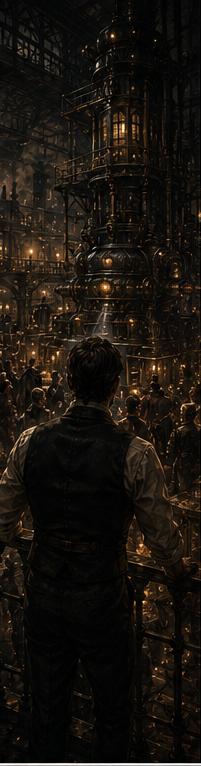
The revolution's organiser understands power as control of systems, not possession of titles.
Ostrog explains the revolt as a sequence of captured systems.
Labour Companies were organised secretly. The Council's police were concentrated and isolated. Sympathetic aeronauts refused to carry the Council's forces, while rebels seized the great flying stages.
The Council still held formal authority, but Ostrog attacked the channels through which authority could act.
Power, in his account, belongs to whoever controls movement, communication, armed force and public belief.
The operation sounds less like a spontaneous uprising than a carefully engineered takeover.
A device called a speculum gives Graham a remote view of the city.
He sees roof spaces, prisoners in red, blackened ruins and the Council House surrounded by rebels. The same battle he experienced as darkness and panic becomes orderly when viewed from Ostrog's command room.
This difference matters.
Graham knows what the revolution feels like to a body trapped inside it. Ostrog knows how it looks as a system of positions and outcomes.
Each man possesses a kind of knowledge the other lacks.
Ostrog says the Council has no viable escape. Most aeronauts are neutral or sympathetic to the revolt. Large aircraft have been seized; smaller machines cannot land safely near the surrounded building.
Across the world, cities are waiting to see whether London succeeds.
Then Ostrog turns to Graham's immediate duty.
The people must see their Master. Remote cameras can carry Graham's image to darkened halls across continents. He need not deliver a long speech—only a few words and a royal bow.
Ostrog even supplies the sentence: Graham has awakened and his heart is with the people.
Graham says he is in Ostrog's hands.
Ostrog plainly agrees.
Is Ostrog a liberator?
At this point, Ostrog has freed Graham from the Council and organised forces against an unpopular government. That makes him an ally. But he also planned to manufacture an awakened Sleeper if necessary and immediately scripts Graham's public message. The story asks readers to notice both truths before deciding what kind of leader he is.
Why this chapter matters
Ostrog is compelling because he brings coherence. After chapters of confusion, Graham finally meets someone who can explain the whole crisis. Competence creates trust—but it can also conceal domination.
FOR READERS REVISITING WELLS
The prepared double is easy to overlook, yet it reveals how instrumental Graham already is to the movement. Ostrog wanted the authority of the Sleeper whether or not the Sleeper himself could participate.