ARCHIVE 001 · CHAPTER 19
OSTROG'S POINT OF VIEW
Ostrog finally explains the revolution without slogans: equality was useful, hope was a weapon, and now the population must return to obedience.
NO PRIOR KNOWLEDGE REQUIRED · RECORDS 037—038Helen has shown Graham that the blue-clad Labour population lives in managed dependence and expects the awakened Sleeper to bring real change. Graham has resolved to rule for himself and end Labour slavery.
For the first time, Graham listens to Ostrog's daily report with the intention of challenging it.
Ostrog arrives prepared to describe another successful day of administration.
Graham interrupts the vague assurances with direct questions. What happened in Paris and Berlin? Was there fighting? Why are factories still empty? What exactly does the Labour population expect?
Ostrog initially minimises the unrest. A little disorder occurred, he says, and disciplined forces restored control.
Under pressure, he becomes more explicit.
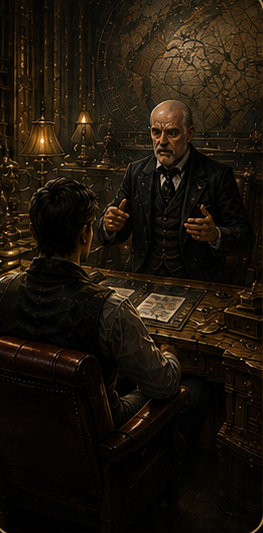
OSTROG'S POINT OF VIEW
Ostrog discards the language of liberation and explains power as administration, wealth and force.
The revolution drew its strength from social discontent.
Workers resented the Labour Department, inequality and the Council's rule. Ostrog's movement deliberately revived old ideas: universal happiness, equality and an end to luxuries unavailable to everyone.
He does not speak of those ideas as goals.
He speaks of them as tools required to overthrow the Council.
The problem, from Ostrog's perspective, is that people believed the promises.
The Council has fallen, but the population remains mobilised. Workers refuse to return to factories. They resist disarmament and imagine that victory entitles them to change the social order.
Ostrog describes this as an outdated humanitarian fever.
The people were useful while they moved against his enemies. Their continued movement is now disorder.
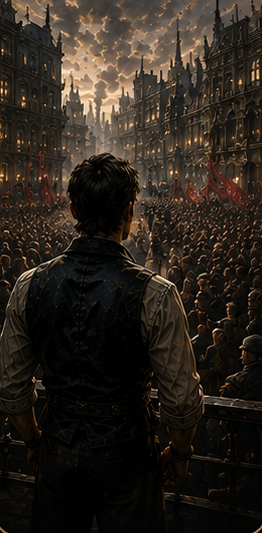
THE REVOLUTION WAS A WEAPON
The hopes used to mobilise workers become a threat the moment they survive victory.
His government is already countering the movement through mass communication—the Babble Machines that repeat suggestions across the city—and through armed force.
In continental cities, troops drawn from colonial territories and controlled by large companies have been used against local crowds.
Wells writes these forces through the racial hierarchy of his period. For a modern reader, the essential political point is that Ostrog relies on people kept outside the rights and ideas of the citizens they are ordered to suppress.
Distance makes them useful to power.
Graham asks whether such measures are compatible with a revolution supposedly made for the people.
Ostrog rejects the premise.
Democracy belonged to an age when ordinary people could decide battles through numbers. Modern power depends on expensive weapons, aircraft, engineering, transport and finance.
Those who control wealth control the systems.
Therefore, in his view, those capable of handling wealth must rule.
The argument is frightening because it is coherent.
Ostrog does not believe himself a hypocrite. He believes equality is technically impossible and that pretending otherwise produces chaos.
Every civilisation needs direction. Every machine has an operator.
The only honest question is whether the operator is competent.
Ostrog traces the decline of democracy through military technology.
When ordinary citizens could determine war through mass participation, they could demand political weight. Once victory depended on costly artillery, strategic transport, specialised engineers and control of the air, wealth became more decisive than numbers.
For Ostrog, this is not corruption but history. Political equality cannot survive material inequality in the instruments of power.
Graham hears the diagnosis and rejects the prescription. If concentrated systems produce oligarchy, the answer cannot simply be to make the oligarch competent.
Graham sees the trap in the reasoning.
If complexity always justifies control from above, no amount of progress can ever make ordinary people free. New technology only gives rulers stronger reasons to keep power.
He tells Ostrog that he wants reality rather than official descriptions. He will go through the city, see how people live and inspect the Labour system with his own eyes.
Ostrog agrees, perhaps because refusal would reveal too much. Graham must go disguised, accompanied by Asano.
Before the meeting ends, Graham gives an explicit order: armed colonial forces are not to be brought into London against the population.
Ostrog begins to qualify the promise.
Graham repeats it as a command.
Ostrog bows.
The gesture preserves formal obedience while revealing that the two men no longer share a political purpose.
Graham leaves believing he has asserted authority.
Ostrog leaves knowing that authority without control may be ignored.
What are the Babble Machines?
They are mass-communication systems used to repeat approved ideas and counter revolutionary messages. They are not neutral media. Whoever controls them can shape what millions hear, making information infrastructure part of Ostrog's apparatus of rule.
Why this chapter matters
The ideological conflict becomes explicit here. Graham believes power creates an obligation to enlarge freedom. Ostrog believes complexity makes hierarchy permanent.
FOR READERS REVISITING WELLS
Wells's treatment of colonial troops uses racist language and assumptions from his period. This retelling preserves their political function—outsiders controlled by companies and deployed against citizens—without repeating the dehumanising vocabulary as though it were neutral description.