ARCHIVE 001 · CHAPTER 20
IN THE CITY WAYS
Disguised as an ordinary official, Graham enters the living city and discovers that the world presented to its Master was only a protected corner of it.
NO PRIOR KNOWLEDGE REQUIRED · RECORDS 039—040Graham and Ostrog have broken politically. Ostrog admits that equality was a slogan used to win the revolution, while Graham has ordered that force not be brought against London and insists on seeing ordinary life himself.
At night, hidden beneath the clothes of a minor wind-vane official, the owner of the world enters his own city anonymously.
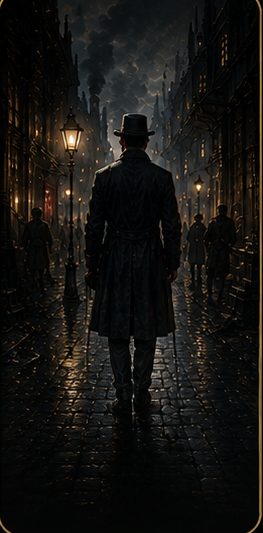
THE MASTER IN DISGUISE
Anonymity lets Graham see what ceremony and guards kept outside his view.
Asano accompanies him dressed in the blue canvas of the Labour Department.
The disguise removes Graham from ceremony. No guards clear a path. No crowd sees the black-robed Sleeper. For the first time, he can observe people who do not know they are being observed by the Master.
The city is at its busiest.
Commerce continues despite the revolution, pouring through the Moving Ways in colour, noise and light.
Political unrest remains visible everywhere.
Blue-clad workers move past carrying rough banners demanding that they not be disarmed. Their procession travels seated on the Ways, an old form of protest adapted to mechanical streets.
Asano remarks that they should be at work and may have gone without food.
The comment reveals his position. He can explain the system, but he has also learned to regard its discipline as normal.
Bodies from the earlier fighting are still being carried from hospitals to mortuaries.
Black decorations celebrate Graham's victory while the dead created by that victory move through the same streets.
Fragments of argument reach him in dialects shaped by class and limited education.
The unrest that Ostrog described as a manageable disturbance is a continuous pressure throughout the city.
Other sights interrupt the politics.
Religion has become commercial spectacle, advertised through moving images and competitive promises. Entertainment districts offer pleasures with an efficiency resembling industry.
Graham sees institutions that once claimed moral authority now marketing themselves through the language of speed, convenience and price.
The future has not abandoned belief. It has reorganised belief as a service.
He encounters a vast crèche operated by an international organisation.
Infants are kept, fed and monitored through glass, machinery and trained attendants while parents pursue work or entertainment elsewhere.
The system is technologically impressive and emotionally unsettling.
Among wealthier classes, birth rates have fallen. Among the Labour population, children continue entering a structure that may determine their status before they can choose.
In a dance hall, Graham sees parents finding leisure while children are managed collectively. Elsewhere, he crosses markets, amusements and institutions whose purposes he can only partly decipher.
Every district reveals a civilisation that has solved practical problems at immense scale.
Every solution also creates a new form of dependence on whoever operates it.
The pattern mirrors Graham's own condition: service and control arriving together.
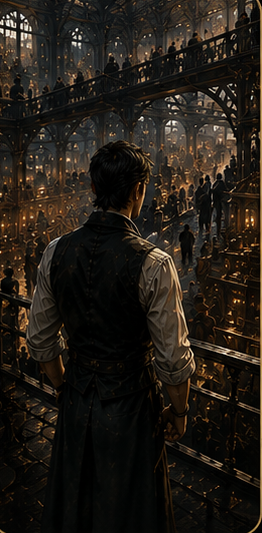
IN THE CITY WAYS
Commerce, protest, entertainment and speculation coexist inside a city that never truly stops.
The business quarter is more disturbing.
Crowds speculate on lives through insurance and annuity markets. Graham discovers that enormous sums are being wagered on his own survival.
Because his awakening has made his future uncertain, the supposed safest life in history has become a gambling instrument.
People press toward screens showing changing prices while the person whose death they are pricing stands among them unnoticed.
The market treats the Master as another asset.
Graham has had enough of prominent institutions and speculative crowds.
He tells Asano that these are not the people he came to see.
He wants the workers—the men, women and children in blue whose labour supports the brilliant city.
Asano leads him away from the commercial Ways.
They begin travelling toward the manufacturing quarter.
The lights grow fewer.
The architecture grows heavier.
The visible future is about to give way to its Under-side.
Why does the disguise matter?
Graham's public image changes behaviour around him. Officials stage what he sees, guards remove inconvenience and crowds respond to the legend. Disguise lets him encounter institutions and ordinary reactions without the distortions produced by his title.
Why this chapter matters
The chapter is deliberately crowded. Graham sees too much to interpret fully, which recreates the experience of a newcomer moving through a society whose assumptions are invisible to its residents.
FOR READERS REVISITING WELLS
The life-insurance market is a particularly sharp reversal. Graham's estate once grew because his life seemed almost indefinitely secure; now his political danger turns that same life into a speculative price.