ARCHIVE 001 · CHAPTER 21
THE UNDER-SIDE
Beneath the luminous city, Graham finally sees the people and machinery that make its abundance possible.
NO PRIOR KNOWLEDGE REQUIRED · RECORDS 041—042Disguised and accompanied by Asano, Graham has crossed London's commercial, religious and entertainment districts. After discovering that strangers are even gambling on his life, he asks to see the blue-clad workers.
The descent changes the city before Graham meets a single worker.
The Moving Ways carry Graham and Asano away from the business quarter toward the manufacturing districts.
They cross the Thames, now a dark channel of seawater roofed over by buildings, and pass above a vast tunnel where silent vehicles transport goods into London.
Blue canvas appears everywhere: on barge crews, drivers and people moving between shifts.
The colour that seemed incidental when Graham first woke now becomes the uniform of an entire economic class.
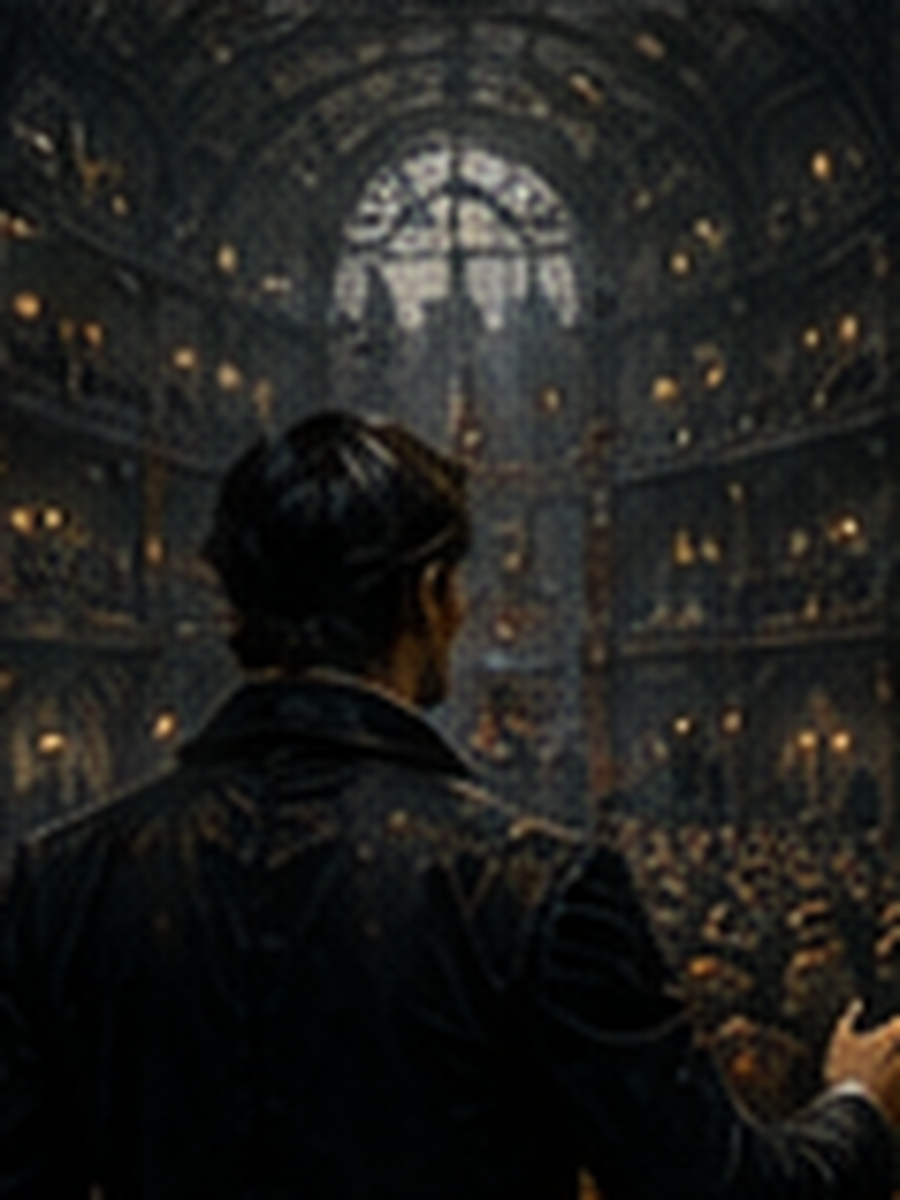
THE UNDER-SIDE
Ornament and natural light disappear as Graham descends beneath the public city.
They leave the public Ways and descend by lift.
Then they descend again.
Decoration disappears. Lights become smaller and farther apart. Walls, columns and structural supports grow heavier as though the architecture itself is carrying the weight of the city above.
The future's public face was designed to impress. Its industrial body is designed only to endure.
The manufacturing quarter is not one factory but a buried world.
Graham passes food production, mineral mills, furnaces, metalworks and lakes of incandescent material used in future construction.
Some galleries are silent because the strike has emptied them. In others, labour continues slowly among machines stretching beyond sight.
Wherever work is being done, men, women and children wear blue.
The machinery has eliminated much of the heavy muscular labour Graham remembers from Victorian industry.
That has not liberated the worker.
People now feed, watch, clean and tend machines whose pace and purpose are determined elsewhere. The body is less often used as raw power, but the person's time remains controlled.
Supervisors and Labour Police stand apart in better clothing. Their health and confidence contrast with the fatigue of those they direct.
Automation has changed the form of exploitation, not removed it.
Graham sees the Labour Department as a physical system for the first time.
Housing, work, food and discipline connect through the same institution. A person dependent on one part is dependent on all of it.
The system calls this security. Nobody need starve outside employment because the Department assigns employment.
The price is that refusal becomes almost impossible.
Helen's phrase—Labour slavery—no longer sounds rhetorical.
In a jewellery gallery, workers sit separately under small shaded lamps, their fingers moving through coils of gold while their faces remain in shadow.
The image disturbs Graham more than a roaring furnace.
Luxury is being produced in near darkness for people who live in brilliant halls.
The gold passes upward. The workers remain below.
Graham's own estate may own both the workshop and the market that sells its output.
THE MASTER IS BETRAYED
The workers learn that Ostrog may be bringing armed forces against London despite Graham's order.
News begins travelling through the Under-side faster than Graham and Asano can verify it.
Ostrog has summoned armed forces from outside London. The same colonial police used against unrest abroad may be approaching the city by air.
Workers shout that the Master has been betrayed.
The phrase is politically convenient—they do not know Graham is standing among them—but this time it may also be true.
Graham explicitly ordered Ostrog not to bring those forces to London.
Asano is shaken. He cannot understand how the rumour spread before official confirmation.
A worker says that a girl escaped from the Council House and warned people in the ruins.
Graham immediately thinks of Helen.
The crowd begins demanding that all work stop and that every person return to their ward for weapons and instructions.
The Under-side does not erupt because Graham commands it. It erupts because people believe the government has broken faith.
The hour Graham and Helen anticipated has arrived.
He must return to the Council House and confront Ostrog openly.
Why call it the Under-side?
The name is literal and social. Manufacturing, labour housing and service systems occupy levels beneath the public city. The people whose work supports London's visible splendour are physically separated from it, making class hierarchy part of the architecture.
Why this chapter matters
This is the chapter where Graham's argument with Ostrog stops being theoretical. Efficiency, order and managed dependence become rooms, uniforms, tired bodies and unequal light.
FOR READERS REVISITING WELLS
Wells describes the working population through some class-bound and pseudo-biological assumptions typical of his era. This retelling retains the structural critique—poor nutrition, inherited dependence and unequal opportunity—without presenting social hierarchy as a natural difference between kinds of people.